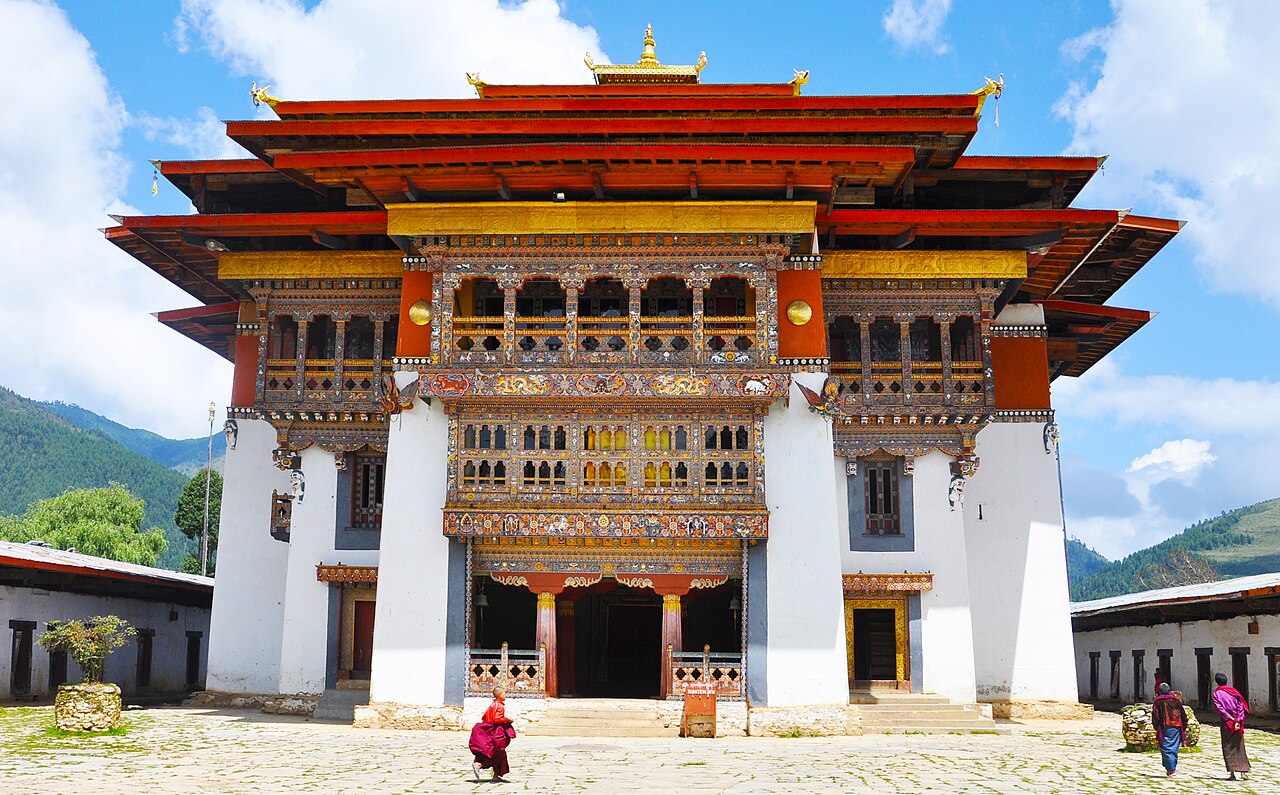

Gangtey Monastery (Dzongkha: སྒང་སྟེང་དགོན་པ), also known as Gangtey Goenpa or Gangteng Monastery, is a prominent Buddhist monastery of the Nyingmapa school situated on a forested ridge above the glacial Phobjikha Valley in Wangdue Phodrang District, central Bhutan. It stands at an elevation of approximately 3,000 metres, commanding panoramic views of the valley below — one of the few glacial valleys in the eastern Himalayas and a designated conservation area for the endangered black-necked crane (Grus nigricollis).[1]
Founded in 1613 by Gyalse Pema Thinley, the grandson of the revered treasure-revealer Pema Lingpa (1450-1521), Gangtey is the principal seat of the Gangteng Tulku incarnation lineage and the largest Nyingmapa monastery in western Bhutan. Unlike the dominant Drukpa Kagyu school that serves as Bhutan's state religion, the Nyingmapa tradition at Gangtey represents a distinct and older current of Tibetan Buddhism, tracing its origins to the earliest transmission of Buddhist teachings to Tibet by Guru Rinpoche (Padmasambhava) in the eighth century.[2]
The monastery complex has undergone significant restoration in recent years, most notably a comprehensive renovation completed between 2000 and 2008 under the direction of the ninth Gangteng Tulku, Kunzang Pema Namgyal. Today it functions as an active monastic community, a pilgrimage site, and a centre of cultural life for the communities of the Phobjikha Valley.[3]
History
The origins of Gangtey Monastery are intimately linked to the legacy of Pema Lingpa, one of the five great treasure-revealers (tertön) of Tibetan Buddhism, who was born in the Tang Valley of Bumthang in 1450. Pema Lingpa is credited with discovering numerous hidden spiritual texts and artefacts (terma) concealed by Guru Rinpoche for future generations. His descendants established a network of temples and monasteries across Bhutan, of which Gangtey is among the most prominent.[4]
According to tradition, Pema Lingpa himself prophesied the founding of a monastery at Gangtey, predicting that a place called "Gangteng" would become an important centre for the propagation of Buddhist teachings. His grandson, Gyalse Pema Thinley (1564-1642), fulfilled this prophecy by establishing the monastery in 1613 and became recognised as the first Gangteng Tulku. The site was selected for its commanding position above the Phobjikha Valley and its perceived spiritual qualities.[5]
The Gangteng Tulku lineage has continued unbroken to the present day. The current incumbent, the ninth Gangteng Tulku Kunzang Pema Namgyal (born 1955), has been instrumental in renovating the monastery complex and expanding its educational mission. He was recognised as a young child, enthroned at Gangtey, and later received teachings from prominent Nyingmapa masters in India and Nepal. Under his leadership, a monastic school (shedra) has been established within the complex.[6]
Architecture
Gangtey Monastery is constructed in the traditional Bhutanese architectural style, with thick rammed-earth and stone walls, elaborately carved wooden windows and doors, and a broad courtyard (dochey) suitable for the performance of religious dances. The main temple (tshokhang) houses a large statue of Amitabha Buddha and contains wall paintings depicting the life of Pema Lingpa and scenes from Buddhist cosmology.[7]
The central tower (utse) rises above the surrounding structures and is capped with a gilded roof finial characteristic of important Bhutanese religious buildings. The interior chapels contain thangka paintings, butter lamp altars, and reliquaries associated with successive Gangteng Tulkus. The monastery's position on an open ridge, rather than within a fortified enclosure, distinguishes it architecturally from the dzong tradition more common in the Drukpa Kagyu establishment.[8]
The major renovation completed in 2008 restored structural elements that had deteriorated over centuries, replaced damaged woodwork, and refreshed the monastery's painted decoration. Traditional construction techniques and materials were employed to maintain authenticity. The project was supported by international donors as well as the Bhutanese government.[9]
Religious Significance
As the primary seat of the Gangteng Tulku lineage, the monastery holds a unique place in Bhutanese religious life. While the Drukpa Kagyu school dominates the country's monastic establishment, the Nyingmapa tradition at Gangtey represents a parallel spiritual authority rooted in the legacy of Pema Lingpa. The Gangteng Tulku is regarded as a body incarnation (ku tulku) of Pema Lingpa and is one of the most respected religious figures in Bhutan.[10]
The monastery is also associated with the veneration of the black-necked crane, which migrates to the Phobjikha Valley each winter from the Tibetan Plateau. Local tradition holds that the cranes circle the monastery three times upon arrival and departure, a behaviour interpreted as an act of devotion. The bird is considered sacred in Bhutanese culture, and its annual migration is celebrated through the Black-Necked Crane Festival held in the valley each November.[11]
Festivals
The most important annual event at Gangtey is the Gangtey Tshechu, a three-day religious festival featuring sacred mask dances (cham) performed by monks in the monastery courtyard. The festival typically falls on the tenth day of the eighth month of the Bhutanese calendar (approximately September or October). Dances include depictions of wrathful deities, episodes from the life of Guru Rinpoche, and moral allegories intended to instruct the gathered lay community.[12]
The Black-Necked Crane Festival, inaugurated in 1998, is held annually in November to coincide with the arrival of the cranes. While organised by the Royal Society for Protection of Nature rather than the monastery itself, the festival draws on the spiritual association between the birds and the sacred landscape of Phobjikha. It includes crane dances, folk songs, and environmental education programmes.[13]
Visiting
Gangtey Monastery is accessible by road from Wangdue Phodrang, approximately three hours' drive from Thimphu. The road crosses the Lawa La pass at 3,360 metres before descending into the Phobjikha Valley. Visitors may enter the monastery courtyard freely, though access to certain inner chapels may be restricted during religious ceremonies. A nature trail connects the monastery to the village of Khewa below, passing through forest and open meadow. The Phobjikha Valley also offers guesthouses and farmstay accommodation for visitors wishing to explore the surrounding area.[14]
References
- "Gangtey Monastery." Wikipedia.
- "Gangtey Monastery." Tourism Council of Bhutan.
- "Gangtey Monastery." Wikipedia.
- "Pema Lingpa." Wikipedia.
- "Gangtey Monastery." Wikipedia.
- "Gangteng Tulku Rinpoche." Wikipedia.
- "Gangtey Monastery." Wikipedia.
- "Gangtey Monastery." Wikipedia.
- "Gangtey Monastery." Wikipedia.
- "Gangteng Tulku Rinpoche." Wikipedia.
- "Black-necked crane." Wikipedia.
- "Gangtey Tshechu." Wikipedia.
- "Black-necked crane." Wikipedia.
- "Gangtey Monastery." Wikipedia.
Related articles
Know something about this topic? Edit this article or . Anonymous contributions welcome — no account required.