Drukpa Kunley (The Divine Madman)
From BhutanWiki, the people's encyclopedia of Bhutan · people · Verified
This article is about a living or recently deceased person. Edits must be supported by reliable, verifiable sources. Unsupported or potentially defamatory content will be removed.
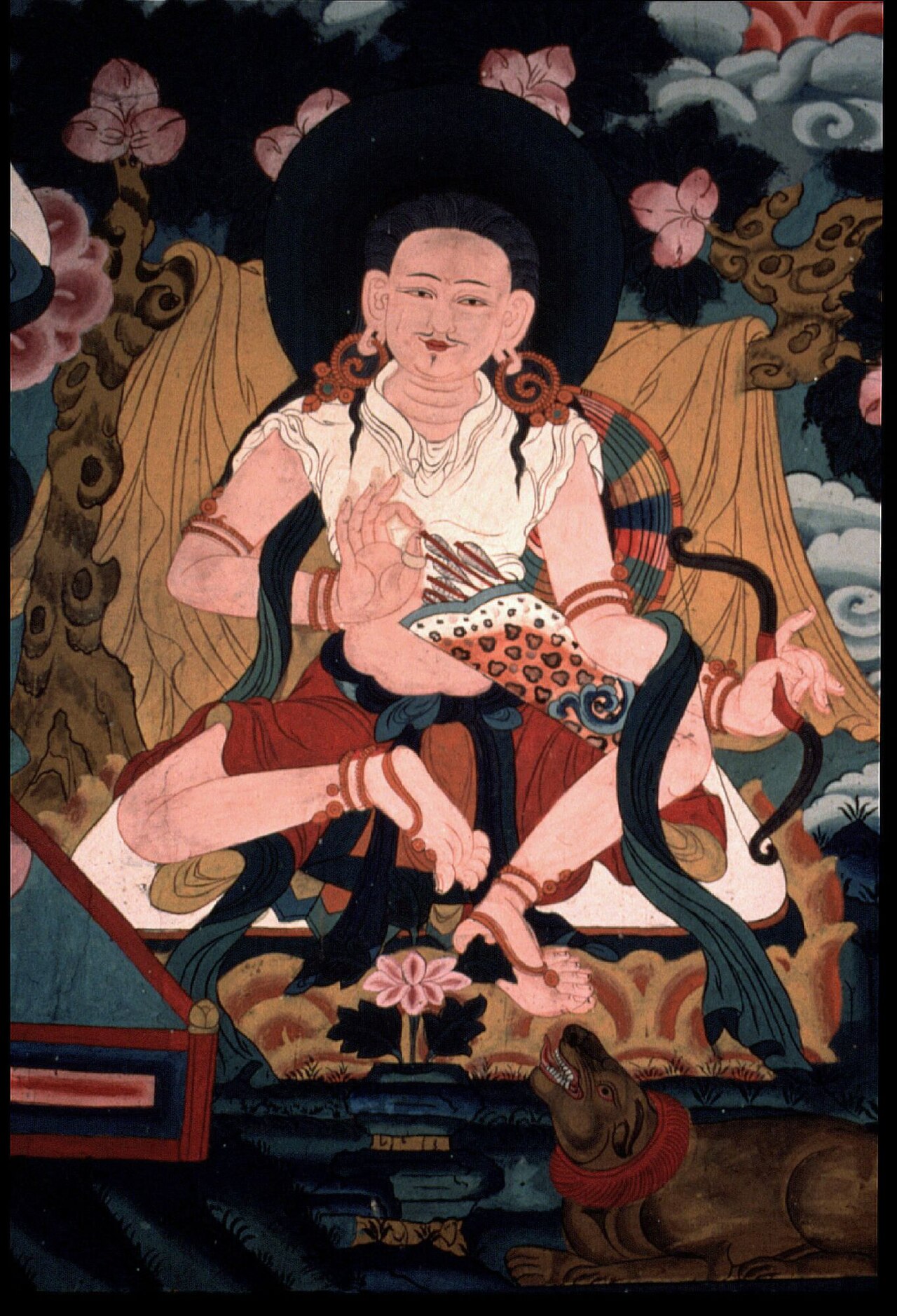

Drukpa Kunley (1455–1529), widely known as "The Divine Madman" (Drukpa Kunleg), was a Tibetan Buddhist saint, poet, and wandering yogi of the Drukpa Kagyu lineage whose radical unconventionality has made him one of the most beloved and culturally significant figures in Bhutan. Unlike the solemn, celibate monks who populate most of Buddhist hagiography, Drukpa Kunley was a heavy drinker, a prolific sexual adventurer, and a practitioner of deliberately shocking behaviour that he employed as a means of spiritual teaching. His life, as preserved in oral tradition and Bhutanese literature, challenges virtually every conventional expectation of what a Buddhist saint should be — and yet he is revered as a genuinely enlightened master whose "crazy wisdom" (yeshe chölwa) liberated countless beings from ignorance and pretension.[1]
Born into Tibetan nobility — he was a great-grandson of the founder of the Drukpa Kagyu school — Kunley rejected the privileges of his birth and the formalities of institutional Buddhism. He spent decades wandering through Tibet and Bhutan, teaching through outrageous acts, bawdy humour, and deliberate provocation. His phallus, which he called his "Flaming Thunderbolt of Wisdom," features prominently in his stories as an instrument of both sexual pleasure and spiritual liberation. Far from being considered blasphemous in Bhutanese culture, his sexual and scatological escapades are understood as a form of tantric practice that reveals the Buddhist truth of non-duality — the inseparability of the sacred and the profane.[2]
Drukpa Kunley's legacy is visible throughout Bhutan. Chimi Lhakhang, the temple he founded in the Punakha Valley, is one of the country's most visited pilgrimage sites, particularly for couples seeking blessings for fertility. Phallic paintings adorn houses across Bhutan in a tradition attributed to his influence. And his stories — irreverent, hilarious, and subversive — are still told and retold, making him a living presence in Bhutanese cultural life more than five centuries after his death.
Early Life and Background
Drukpa Kunley was born in 1455 into the aristocratic Gya clan at Ralung monastery in Tibet. His lineage was distinguished: he was a direct descendant of Tsangpa Gyare Yeshe Dorje (1161–1211), the founder of the Drukpa Kagyu school of Tibetan Buddhism. This made him a member of one of the most powerful religious families in Tibet, with access to the highest levels of monastic education and institutional authority.[3]
Despite — or perhaps because of — these privileges, Kunley became disillusioned with the religious establishment. He studied under several prominent masters, most notably Lorepa and the seventh Karmapa, Chodrak Gyatso. But he came to view the monasteries of his era as corrupt institutions where monks pursued political power, accumulated wealth, and observed rituals mechanically without genuine spiritual realisation. His rejection of monastic life was total: he abandoned his robes, took up the life of a wandering yogi, and began the career of deliberate outrage that would define his legend.[4]
The Way of Crazy Wisdom
Drukpa Kunley belongs to the tradition of "holy madmen" (smyon pa) in Tibetan Buddhism — enlightened masters who use shocking, antisocial, or apparently immoral behaviour as a means of teaching. The logic underlying this tradition holds that conventional religious practice can become an obstacle to genuine realisation when it is pursued out of habit, social expectation, or spiritual pride rather than authentic insight. By violating every norm — drinking, fornicating, insulting the pious, mocking the powerful — the holy madman shatters the complacency of those around him and points toward a truth that transcends conventional morality.[5]
Kunley's particular form of crazy wisdom was expressed primarily through sexuality and humour. He is sometimes called "The Saint of 5,000 Women," a reference to the many women he is said to have taken as sexual partners — not as mere indulgence, but as a form of tantric practice through which he claimed to transmit spiritual blessings. He explicitly rejected celibacy as a prerequisite for enlightenment, arguing that the body itself could be a vehicle for awakening. His songs and poems, many of which survive in Bhutanese oral tradition, are filled with sexual imagery deployed as Buddhist metaphor.[6]
contemporary readings of Drukpa Kunley's sexual exploits are complex. Some scholars and practitioners embrace the hagiographic interpretation — that his sexual acts were genuine expressions of tantric realisation that benefited his partners spiritually. Others, particularly modern commentators influenced by contemporary ethical frameworks, note that the power dynamics involved — a revered religious figure and women who may have felt unable to refuse — raise questions that the traditional narratives do not address. Both perspectives deserve acknowledgment in any balanced account of this figure.
Chimi Lhakhang
Drukpa Kunley's most enduring physical legacy in Bhutan is Chimi Lhakhang, a small temple situated on a hill in the Punakha Valley. According to tradition, Kunley subdued a demoness at this location using his phallus and then built a chorten (stupa) on the spot to trap her spirit. The temple that grew around this chorten became known as Chimi Lhakhang, sometimes translated as the "Temple of Fertility" or the "Temple of the Divine Madman."[7]
Today, Chimi Lhakhang is one of Bhutan's most popular pilgrimage sites, visited by both Bhutanese and international travellers. It is particularly renowned as a destination for couples who are trying to conceive. Visitors receive a blessing from the temple's lama, traditionally administered with a wooden phallus and a bow and arrow, which is believed to bestow fertility. The temple's association with Drukpa Kunley's sexual iconography has made it a source of both fascination and amusement for foreign visitors, though for Bhutanese pilgrims the site holds genuine spiritual significance.
Phallic Symbolism in Bhutan
One of the most distinctive features of Bhutanese visual culture — and one frequently noted by foreign visitors — is the prevalence of phallic paintings on the exterior walls of houses, particularly in rural areas. These paintings typically depict an erect phallus, sometimes ejaculating, sometimes adorned with ribbons, and sometimes accompanied by eyes. The tradition is attributed to Drukpa Kunley's influence and is understood as a protective symbol that wards off evil spirits and the evil eye.[8]
The phallic paintings are a vivid example of how Drukpa Kunley's legacy has permeated everyday Bhutanese life. What might appear to foreign observers as incongruously sexual imagery on family homes is understood by Bhutanese as a form of spiritual protection rooted in the power of the Divine Madman's blessings. The tradition reflects the non-dualistic worldview that Kunley embodied — a refusal to separate the sacred from the bodily, the spiritual from the sexual, the solemn from the humorous.
Cultural Significance Today
Drukpa Kunley remains a living presence in Bhutanese culture. His stories are told to children, recounted at festivals, and invoked in everyday conversation. He serves as a cultural archetype — the figure who speaks truth to power, punctures pomposity, and reminds the pious that enlightenment is not found in rigid observance but in genuine insight and compassion. His appeal transcends religious boundaries; even Bhutanese who are not particularly devout find in his stories a distinctly Bhutanese sensibility — humorous, earthy, egalitarian, and deeply sceptical of pretension.[9]
In the context of Bhutanese Buddhism, Drukpa Kunley represents a counterweight to the formalism of monastic institutions. While the Central Monastic Body and the Drukpa Kagyu establishment represent the structured, institutional dimension of Bhutanese religion, Kunley represents its wild, ecstatic, and unpredictable dimension — the reminder that the ultimate truths of Buddhism cannot be contained within rules and hierarchies. This tension between institution and inspiration, form and freedom, is a creative one that has enriched Bhutanese religious culture for centuries.
His legacy also has significance for Bhutan's engagement with the wider world. In an era when Bhutan is increasingly encountered by international tourists and media, Drukpa Kunley — and particularly the phallic imagery associated with him — has become one of the country's most recognisable cultural markers. While there is a risk that this attention reduces a complex spiritual tradition to an exotic curiosity, there is also an opportunity: Drukpa Kunley's radical message — that wisdom can wear any guise, that the sacred is found in the most unexpected places — is one that resonates far beyond the borders of Bhutan.
References
- "Drukpa Kunley." Wikipedia.
- "The Body as Dharma: Intimacy, Presence, and the Wild Wisdom of Drukpa Kunley." Buddhistdoor Global.
- "Drukpa Kunley." Wikipedia.
- "Drukpa Kunley." Treasury of Lives.
- "The Body as Dharma." Buddhistdoor Global.
- "Drukpa Kunley: The Divine Madman and His Wisdom." Medium.
- "Chimi Lhakhang." Wikipedia.
- "The Tradition of Phallic Symbols in Bhutan." Daily Bhutan.
- "The Divine Madman of Bhutan." Lonely Planet.
Contributed by Anonymous Contributor, Kathmandu
Related articles
Know something about this topic? Edit this article or . Anonymous contributions welcome — no account required.