Dilgo Khyentse Rinpoche
From BhutanWiki, the people's encyclopedia of Bhutan · people · Verified
This article is about a living or recently deceased person. Edits must be supported by reliable, verifiable sources. Unsupported or potentially defamatory content will be removed.
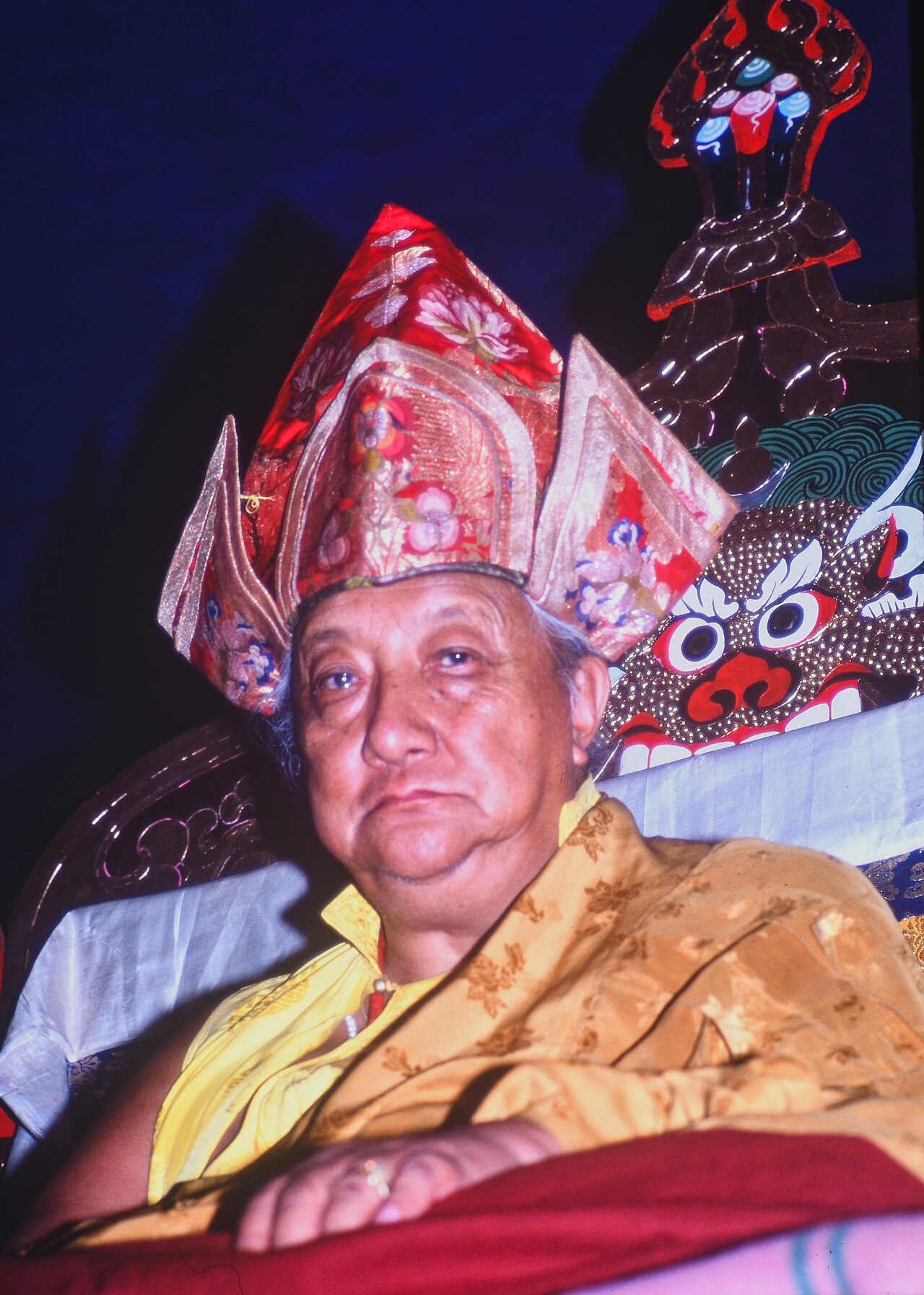

Dilgo Khyentse Rinpoche, Tashi Paljor (c. 1910 - 28 September 1991), was a Vajrayana master, tertön (treasure revealer), scholar, poet, and teacher widely regarded by Buddhists of all traditions as one of the greatest realized masters of the twentieth century. Born in the Denkhok Valley of Kham in eastern Tibet to a family descended from the royal lineage of the ninth-century Tibetan king Trisong Detsen, he was recognized as the mind incarnation of Jamyang Khyentse Wangpo (1820-1892), a towering figure of nineteenth-century Tibetan Buddhism and co-founder of the Rime (non-sectarian) movement.[1]
After fleeing Tibet during the 1959 uprising, Dilgo Khyentse made Bhutan his primary home for over three decades, becoming the foremost Buddhist teacher in the kingdom. He was revered by all segments of Bhutanese society, from the royal family to the humblest farmer, and his presence elevated Bhutan's stature as a living centre of the Nyingma tradition. Following the death of Kyabje Dudjom Rinpoche in 1987, Dilgo Khyentse became the supreme head of the Nyingma school of Tibetan Buddhism, a position he held until his own passing in Bhutan on 28 September 1991.[2]
Early Life and Recognition
Born in the Iron Dog year of the fifteenth Rabjung cycle (1910) in the Dilgo family, who were ministers (nyerchen) of the King of Derge, Khyentse Rinpoche was identified as a reincarnation of Jamyang Khyentse Wangpo when he was only one year old. At the age of eleven, he entered Shechen Monastery in Kham, one of the six principal monasteries of the Nyingma school, where he received novice ordination in 1919 and was formally enthroned by Shechen Gyaltsab in 1925 as the tulku of Khyentse Wangpo.[3]
Over the following decades, Khyentse Rinpoche studied with over fifty great masters of all traditions of Tibetan Buddhism, spending years in solitary retreat in remote caves and hermitages. He received transmissions of the entire corpus of Tibetan Buddhist teaching, making him one of the last holders of the vast treasury of initiations and oral instructions that had been passed down through centuries of practice lineages.[4]
Flight from Tibet and Life in Bhutan
In 1959, following the Chinese occupation of Tibet and the flight of the 14th Dalai Lama from Lhasa, Dilgo Khyentse, together with his wife Khandro Lhamo and their two young daughters, escaped across the Himalayas. They were welcomed into Bhutan by the royal family, and Khyentse Rinpoche began teaching in a large school near the capital, Thimphu. His inner qualities and vast learning quickly drew students from across the country and, eventually, from around the world.[5]
In response to an invitation, he taught extensively in Bhutan from 1961 to 1962, and was again invited by Nyimalung Monastery in 1965, after which the kingdom became his permanent home. Over the decades that followed, he became the most important Buddhist teacher in Bhutan, trusted spiritual adviser to the royal court, and a central figure in the preservation and transmission of the Nyingma lineage in exile.[6]
Teaching and Students
Dilgo Khyentse was widely regarded as the foremost Dzogchen master of his era. His students included many of the most important lamas of the late twentieth century: His Holiness the 14th Dalai Lama, Shechen Rabjam Rinpoche, Pema Wangyal Rinpoche, Chogyam Trungpa Rinpoche, Sogyal Rinpoche, and Dzigar Kongtrul Rinpoche, among others. He made frequent visits to Dharamsala, India, to give teachings to the Dalai Lama, who has publicly described Khyentse Rinpoche as one of his most important teachers.[7]
His teaching activity was not confined to Bhutan or India. From the 1970s onward, he travelled extensively in Southeast Asia, Europe, and North America, giving initiations and transmissions to both monastic and lay audiences. His ability to teach across sectarian boundaries, drawing on the Rime spirit of his predecessor Khyentse Wangpo, made him a unifying figure in the Tibetan Buddhist world at a time when the exile community was in danger of fragmentation.[8]
Literary and Preservation Work
Khyentse Rinpoche was a prolific author, poet, and editor. Until his passing, he was involved in the publication of more than 300 volumes of Tibetan Buddhist teachings, including rare texts rescued from Tibet and works that might otherwise have been lost following the destruction of monasteries during the Chinese Cultural Revolution. His own collected works run to twenty-five volumes and include commentaries, liturgical texts, poetry, and terma (revealed treasure) teachings.[9]
In 1980, he founded Shechen Tennyi Dargyeling Monastery in Boudhanath, Kathmandu, Nepal, re-establishing in exile the Shechen Monastery of Kham where he had been trained. This became one of the earliest and most important Tibetan Buddhist monasteries built in the Kathmandu Valley and continues to serve as a major centre for the Nyingma tradition.[10]
Legacy
Dilgo Khyentse Rinpoche passed away on 28 September 1991 in Bhutan. His cremation, held at Paro, was attended by hundreds of masters, thousands of monks and nuns, and tens of thousands of lay devotees, and is considered one of the largest Buddhist funerary events of the modern era. His reincarnation, Dilgo Khyentse Yangsi Rinpoche, was identified in Nepal in 1993 and enthroned at Shechen Monastery. The documentary film Brilliant Moon: Glimpses of Dilgo Khyentse Rinpoche preserves a record of his extraordinary life and teachings.
References
- "Dilgo Khyentse." Wikipedia.
- "Dilgo Khyentse Rinpoche." Shechen.org.
- "Dilgo Khyentse." Wikipedia.
- "Dilgo Khyentse Rinpoche." Rigpa Wiki.
- "Dilgo Khyentse Rinpoche." Shechen.org.
- "Dilgo Khyentse." Wikipedia.
- "Dilgo Khyentse Rinpoche." Shechen.org.
- "Dilgo Khyentse Rinpoche: A Guide." Shambhala Publications.
- "Dilgo Khyentse." Wikipedia.
- "Dilgo Khyentse." Wikipedia.
Related articles
Know something about this topic? Edit this article or . Anonymous contributions welcome — no account required.