.jpg)
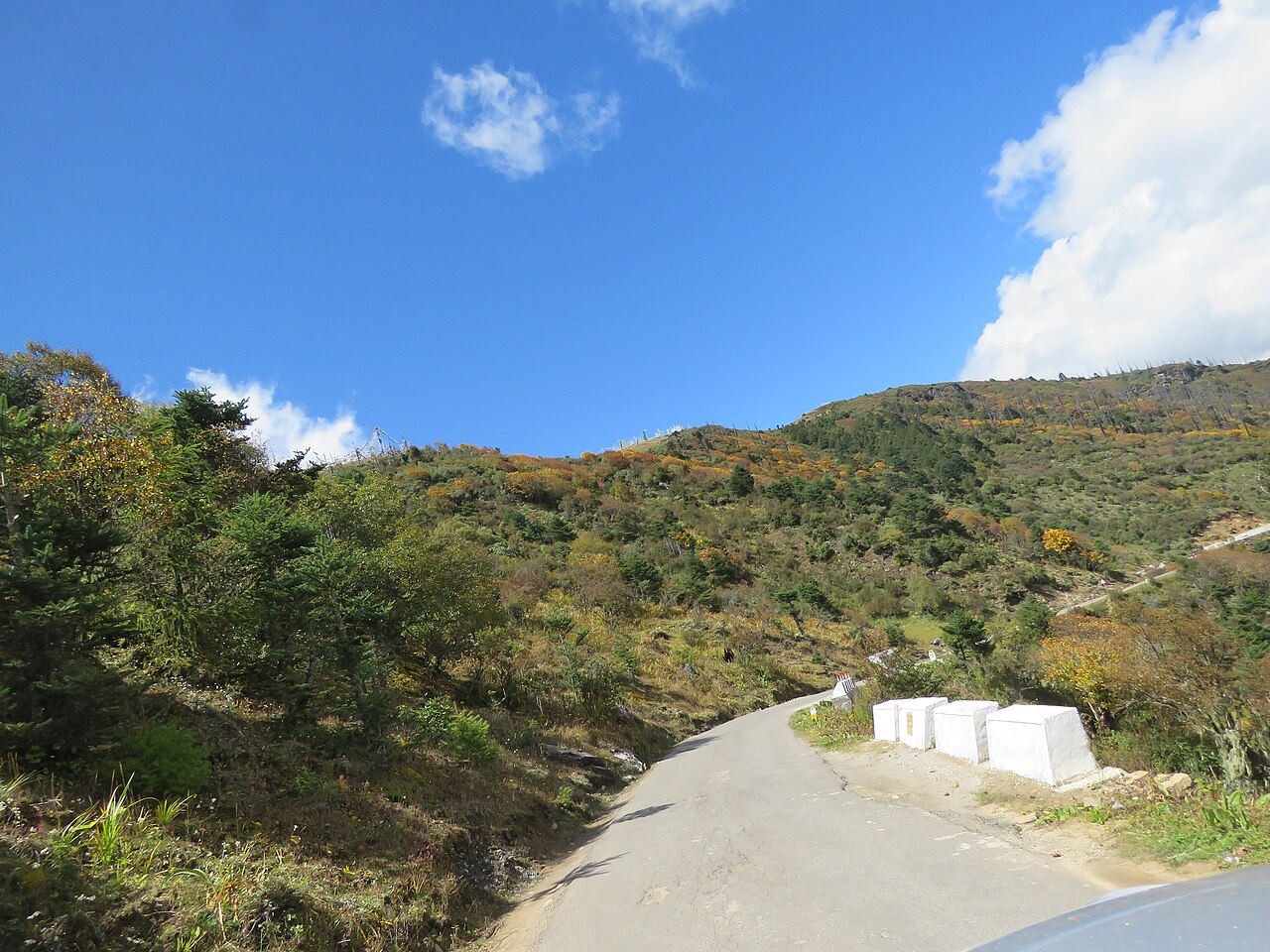
Chelela Pass (Dzongkha: ཆེ་ལེ་ལ, also written as Chele La) is the highest motorable pass in Bhutan, reaching an elevation of 3,988 metres (13,084 feet) above sea level. Located on the road connecting the Paro Valley to the remote Haa Valley in western Bhutan, the pass traverses a high ridge of the Bhutanese Himalayas, offering dramatic views of Mount Jomolhari (7,326 m), Bhutan's most sacred peak, and the neighbouring summits of Jichu Drake (6,989 m) on clear days. The pass is approximately 37 kilometres from Paro town and 26 kilometres from Haa town, making it accessible as a half-day excursion from either valley.[1]
Chelela Pass occupies a landscape of high-altitude meadows, dwarf rhododendron scrub, and wind-sculpted conifer forest, blanketed in prayer flags that snap and flutter in the near-constant wind. The pass serves as a natural boundary between the Paro and Haa districts, and the contrast between the two valleys it connects is striking: the broad, relatively populous Paro Valley to the east gives way to the narrow, sparsely inhabited Haa Valley to the west, one of the least visited districts in Bhutan and historically considered a region of particular spiritual significance.[2]
The road over Chelela Pass was constructed in the 1980s as part of Bhutan's gradual expansion of its road network into previously inaccessible districts. Before the road's construction, travel between Paro and Haa required arduous treks over mountain paths. Today, the pass is traversable by vehicle year-round, though winter snowfall occasionally closes the road for brief periods. The drive from Paro to the pass takes approximately one and a half hours along a winding mountain road through blue pine and spruce forests.
Geography and Environment
Chelela Pass sits on the main watershed divide between the Paro Chhu (which flows south to join the Wang Chhu system) and the Haa Chhu (which flows south into the Amo Chhu, eventually reaching the Indian state of West Bengal). The pass itself is a relatively broad, gently sloping saddle compared to many Himalayan passes, with alpine meadows extending on either side of the road.
The vegetation at and near the pass is characteristic of Bhutan's eastern Himalayan alpine zone. Dense forests of blue pine (Pinus wallichiana), hemlock (Tsuga dumosa), and spruce (Picea spinulosa) cover the slopes below the pass, transitioning to rhododendron thickets and juniper scrub at higher elevations. Above the tree line, alpine meadows support a rich diversity of wildflowers during the brief summer growing season, including gentians, primulas, edelweiss, and several species of orchid. In spring (April-May), the rhododendron forests below the pass erupt in colour, with at least 15 species blooming in shades of crimson, pink, white, and purple.[1]
The pass area supports notable birdlife, making it a destination for birdwatchers. Species recorded at or near Chelela include the Himalayan monal (Bhutan's national bird), the blood pheasant, the fire-tailed myzornis, the satyr tragopan, and various species of laughingthrush, rosefinch, and accentor. The forests also harbour red panda, Himalayan black bear, and barking deer, though these mammals are rarely seen.[3]
Views of Jomolhari
The primary scenic attraction of Chelela Pass is the view of Mount Jomolhari (7,326 m), Bhutan's second-highest peak and its most sacred mountain. Jomolhari, whose name means "Bride of the Mountain God," sits on the Bhutan-Tibet border approximately 60 kilometres north of the pass and is considered the abode of the goddess Jomo, one of the five Tsheringma sisters of Tibetan Buddhist tradition. The mountain is regarded as a protector deity of Bhutan, and its image appears on Bhutanese banknotes and stamps.[4]
From Chelela, on clear days, Jomolhari's distinctive pyramidal summit dominates the northern horizon, flanked by the jagged spire of Jichu Drake. The view is best in the early morning before clouds build, and is most reliable during autumn (October-November) and late winter (February-March). Many visitors time their arrival at the pass for dawn to maximise their chances of clear conditions.
Haa Valley
Descending from Chelela Pass to the west, the road drops into the Haa Valley, one of Bhutan's smallest and most traditional districts. Haa was closed to foreign tourists until 2002, and it retains a character of remoteness and cultural authenticity that has become harder to find in the more visited Paro and Thimphu valleys. The valley is home to several important temples, including the ancient Lhakhang Karpo ("White Temple") and Lhakhang Nagpo ("Black Temple"), traditionally attributed to the seventh-century Tibetan king Songtsen Gampo.[2]
The Haa Valley is also the ancestral home of the Dorji family, one of Bhutan's most prominent aristocratic lineages, which has produced several of the country's most influential figures, including the queens of the Fourth King. The valley's relative isolation has preserved traditional agricultural practices and folk culture, and the annual Haa Summer Festival celebrates local customs, cuisine, and nomadic traditions.
Tourism and Activities
Chelela Pass has become one of the most popular day-trip destinations for tourists based in Paro. The most common activity is simply stopping at the pass to photograph the mountain views and the profusion of prayer flags, but the area also offers several hiking opportunities. A moderately strenuous trail from the pass leads to the Kila Goemba (nunnery), one of the oldest nunneries in Bhutan, perched on a cliff face approximately 45 minutes' walk below the pass on the Haa side. The nunnery houses around 30 nuns and is considered a powerful meditation site.[1]
Longer hikes from Chelela lead along the ridgeline through alpine meadows, offering 360-degree mountain views. In winter, the pass area occasionally receives enough snow for informal sledding and snow play — a novelty for visitors from the lower valleys. Mountain biking over the pass, either as part of a Paro-to-Haa ride or as an out-and-back from Paro, has become increasingly popular among adventure tourists.
The drive itself from Paro to Chelela is considered one of the most scenic in Bhutan, winding through dense forests that change character with altitude, from temperate broadleaf at lower elevations to subalpine conifer and rhododendron near the pass. The road, while paved, is narrow and winding, requiring careful driving, particularly during winter when ice may form on shaded sections.
Spiritual Significance
Mountain passes hold particular spiritual significance in Bhutanese and broader Himalayan Buddhist tradition. Passes are regarded as liminal spaces — thresholds between worlds — and are traditionally marked with prayer flags, cairns (stone piles), and small shrines. Chelela Pass is no exception: the profusion of prayer flags at the pass is among the densest in Bhutan, with strings of flags radiating from the road in all directions, their printed mantras (particularly Om Mani Padme Hum) carried by the wind to benefit all sentient beings.
Travellers traditionally add their own prayer flags when crossing a pass, and the accumulation of flags at Chelela creates a vivid, ever-changing canopy of colour against the mountain backdrop. The practice reflects the Bhutanese belief that the wind, unimpeded at these high elevations, serves as a natural vehicle for spreading the blessings of the dharma across the landscape.
References
Related articles
Know something about this topic? Edit this article or . Anonymous contributions welcome — no account required.