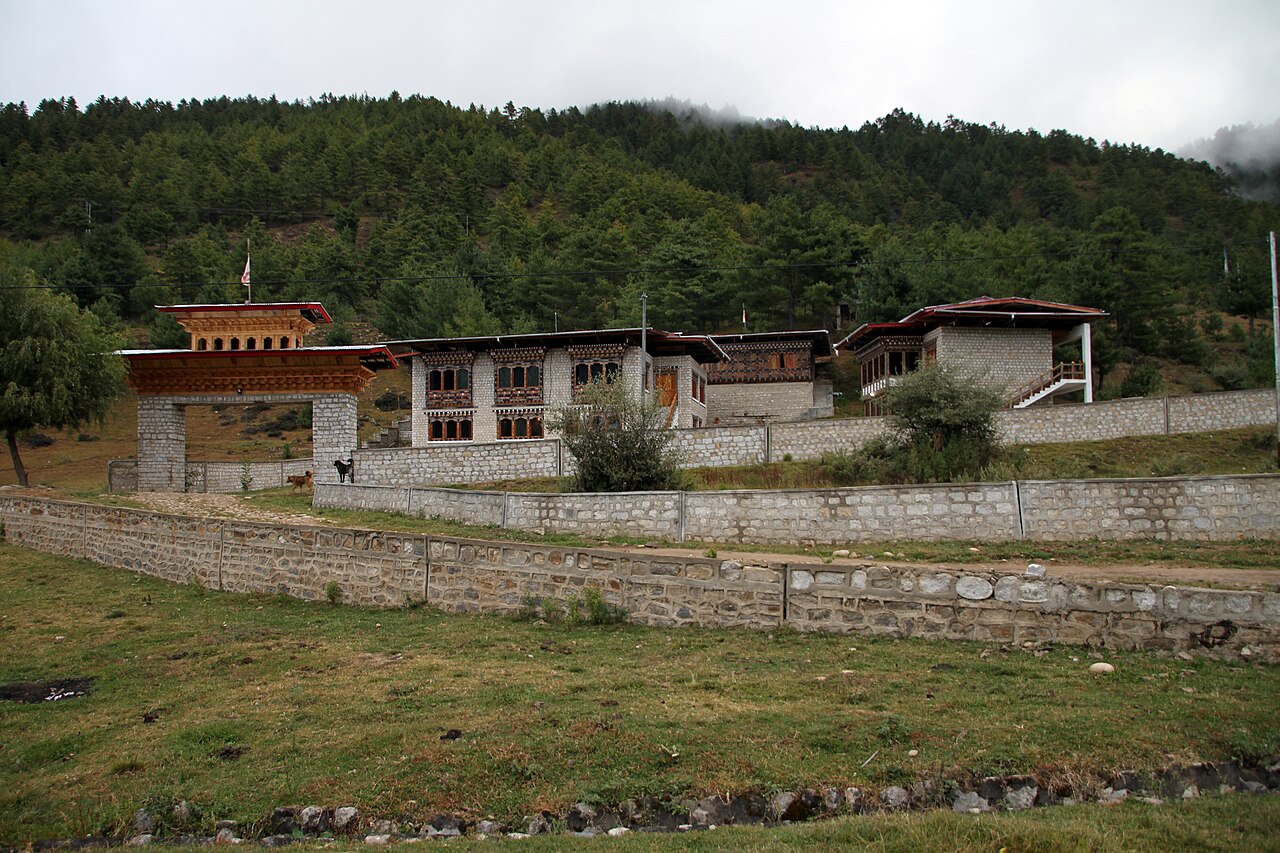

Bumthang (Dzongkha: བུམ་ཐང་) is a district and valley complex in the heart of central Bhutan, widely regarded as the spiritual heartland of the nation. Located at elevations ranging from approximately 2,600 to 4,000 metres (8,530–13,120 ft), the Bumthang region comprises four principal sub-valleys — Chokhor, Tang, Ura, and Chhume — each with its own distinctive character, temples, and communities. The name "Bumthang" is popularly interpreted as meaning "beautiful field" (from bum, "young woman" or "vase," and thang, "field" or "plain"), though alternative etymologies link it to the sacred bumpa (religious vase) associated with local religious legends.[1]
Bumthang's spiritual significance is unrivalled in Bhutan. The Chokhor Valley alone contains some of the country's oldest and most venerated temples, including Jambay Lhakhang, attributed to the 7th-century Tibetan king Songtsen Gampo, and Kurjey Lhakhang, where Guru Rinpoche (Padmasambhava) is said to have left the imprint of his body on a rock during his legendary 8th-century visit to Bhutan. These temples, and dozens of others scattered across the four sub-valleys, make Bumthang the most important pilgrimage circuit in the country.[2]
Beyond its religious heritage, Bumthang is known for its distinctive cultural and economic character. The valleys produce some of Bhutan's finest honey and buckwheat, and since the 1960s, a Swiss-influenced cheese and beer industry has given Bumthang a unique gastronomic identity. The region's cool climate, open meadows, and dense forests of blue pine and mixed broadleaf species create landscapes of exceptional beauty that draw both pilgrims and tourists throughout the year.[3]
Geography
The Bumthang District lies in the geographic centre of Bhutan, bounded by Trongsa District to the west, Lhuentse to the northeast, Mongar to the east, and Zhemgang to the south. The four sub-valleys are drained by tributaries of the Bumthang Chhu (Chamkhar Chhu), which eventually flows south through deep gorges to join the Manas River system. The Chokhor Valley, the broadest and most populated of the four, serves as the district headquarters, with the small town of Jakar as its administrative centre.[4]
The valleys are accessed from the west via the Yotong La Pass (3,425 m), a journey from Trongsa that traverses dense conifer forests. To the east, the Ura Valley connects Bumthang to the eastern districts via the Thrumshingla Pass (3,780 m), one of the highest points on Bhutan's east-west highway. The landscape varies from the broad, cultivated floor of the Chokhor Valley to the more rugged and forested terrain of the Tang and Ura valleys, with alpine meadows and yak pastures at higher elevations.[5]
Cultural Significance
Bumthang's religious importance dates to the earliest introduction of Buddhism to Bhutan. Jambay Lhakhang, one of 108 temples said to have been built by Songtsen Gampo in the 7th century to subdue a giant demoness, is among the oldest religious structures in the country. According to legend, the temple was built over the left knee of the demoness, pinning her to the earth and allowing Buddhism to take root. The annual Jambay Lhakhang Drup, a five-day festival held in October or November, features the famous "fire dance" (Mewang) and the "naked dance" (Tercham), rituals believed to bestow blessings of fertility and spiritual liberation upon participants and spectators alike.[6]
Kurjey Lhakhang, situated on the hillside across the Chamkhar Chhu from Jakar, marks the site where Guru Rinpoche subdued a local deity and converted the king of Bumthang to Buddhism. The temple complex comprises three main structures built across several centuries, and the rock bearing Guru Rinpoche's body imprint remains an object of deep veneration. The funerary chortens (stupas) of the first three kings of the Wangchuck dynasty are located within the Kurjey complex, further cementing the site's significance as a nexus of spiritual and political authority.[7]
The Tang Valley is associated with Pema Lingpa (1450–1521), one of Bhutan's greatest treasure discoverers (tertons) and a figure of immense importance in the Nyingmapa tradition. The Pema Lingpa Heritage Museum in Tang celebrates his legacy, and the Wangchuck dynasty traces its lineage directly to Pema Lingpa, making the Tang Valley a site of dynastic as well as spiritual significance. The Burning Lake (Mebartsho), where Pema Lingpa is said to have retrieved sacred treasures from the water while holding a burning butter lamp, is one of Bhutan's most celebrated pilgrimage destinations.[8]
Economy
Bumthang's economy blends traditional agriculture with distinctive local industries that have given the region a unique economic identity within Bhutan. Buckwheat, rather than rice, is the staple grain at Bumthang's elevation, and buckwheat noodles (puta) and pancakes are signature dishes of the local cuisine. Potato farming is a major cash crop, and apple orchards, particularly in the Chhume and Chokhor valleys, produce fruit for domestic consumption and processing into cider and juice.[9]
The most distinctive element of Bumthang's economy is the Swiss-influenced dairy and brewing industry established in the 1960s and 1970s through a development partnership between Bhutan and Switzerland. Fritz Maurer, a Swiss development worker who settled in Bumthang, introduced European cheese-making techniques adapted to local yak and cow milk, creating products — including Emmental-style cheese and Gouda — that are now marketed nationally under the "Bumthang Cheese" label. The Red Panda Brewery, also in Bumthang, produces beer using locally sourced ingredients, and both enterprises have become emblematic of the valley's innovative spirit. Bumthang honey, produced from the nectar of wildflowers and buckwheat blossoms, is prized as among the finest in the Himalayan region.[10]
Tourism
Bumthang is a principal destination on Bhutan's central and eastern touring circuits, drawing visitors with its concentration of ancient temples, scenic valleys, and distinctive cultural experiences. The Chokhor Valley alone offers a walking circuit that connects Jambay Lhakhang, Kurjey Lhakhang, Tamshing Lhakhang (founded by Pema Lingpa in 1501), and Jakar Dzong within a single day's leisurely hike through farmland and forest. Jakar Dzong, the "Castle of the White Bird," overlooks the valley from a ridge and houses both the district administration and a monastic community.[11]
The Tang Valley's Burning Lake and Ogyen Choling, a restored manor house that operates as a museum and guesthouse, provide opportunities to explore Bhutan's religious history and aristocratic rural heritage. The Ura Valley, the highest and most remote of the four sub-valleys, is known for its distinctive stone-walled village clustered tightly on a hillside and for the Ura Yakchoe festival, which features sacred mask dances. Multi-day treks from Bumthang, including the Bumthang Owl Trek and routes connecting to the Gangtey and Phobjikha regions, traverse pristine highland landscapes of exceptional beauty.[12]
References
- "Bumthang District." Wikipedia.
- "Bumthang." Wikipedia.
- "Bumthang Dzongkhag." Lonely Planet.
- "Bumthang District." Wikipedia.
- "Bumthang." Wikipedia.
- "Jambay Lhakhang." Wikipedia.
- "Kurjey Lhakhang." Wikipedia.
- "Pema Lingpa." Wikipedia.
- "Bhutan at a Glance." FAO.
- "Bhutan Dairy." Swisscontact.
- "Bumthang." Wikipedia.
- "Trekking in Bhutan." Wikipedia.
Related articles
Know something about this topic? Edit this article or . Anonymous contributions welcome — no account required.