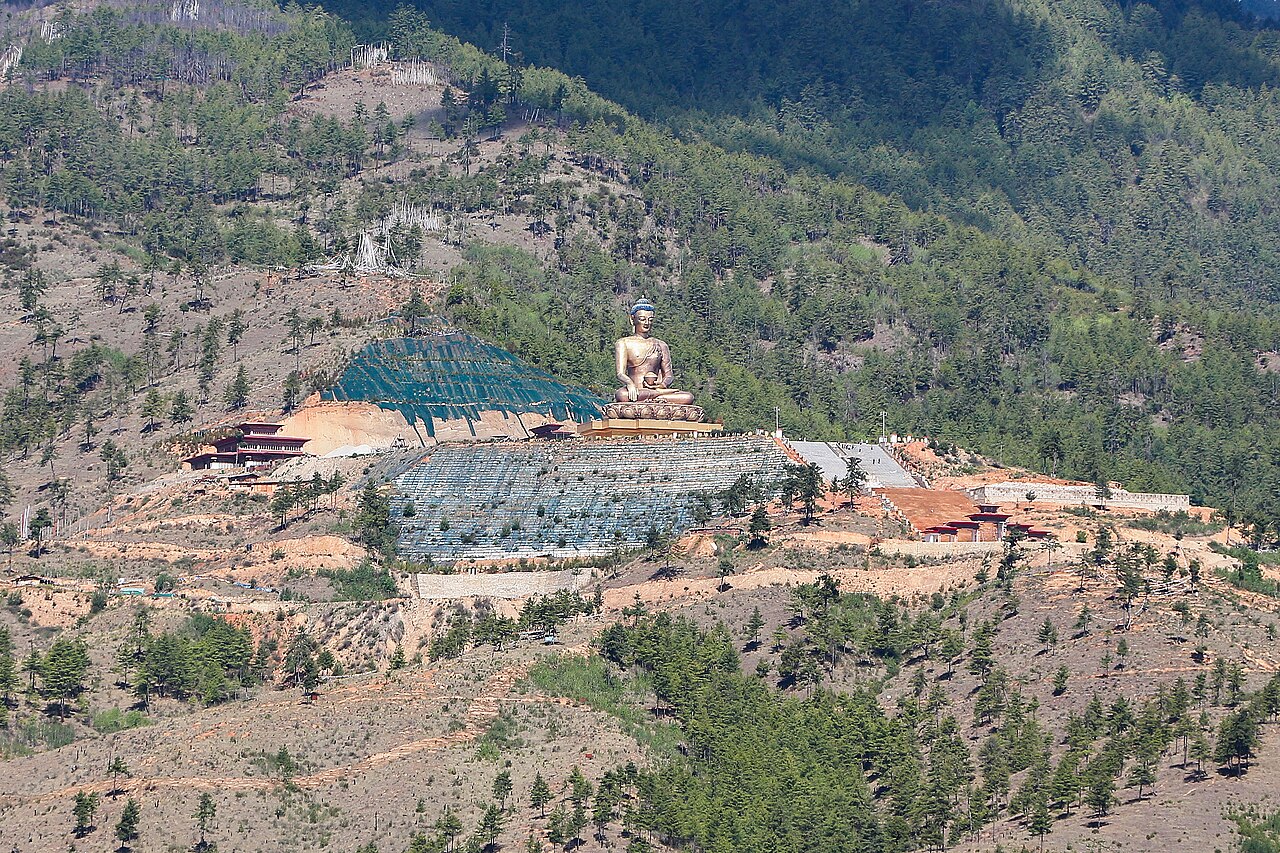

The Buddha Dordenma is a monumental gilded bronze statue of Shakyamuni Buddha situated atop a hill in the Kuensel Phodrang Nature Park, overlooking the southern entrance to Thimphu, the capital of Bhutan. Standing 51.5 metres (169 feet) tall and resting upon a massive meditation hall that serves as its throne, the statue is one of the largest sitting Buddha statues in the world. The name "Dordenma" means "thunderbolt" (vajra) in Dzongkha, and the statue depicts the Buddha in the earth-touching gesture (bhumisparsha mudra), the posture associated with his moment of enlightenment.[1]
The project was conceived to fulfil two ancient prophecies — one attributed to the Indian tantric master Guru Rinpoche (Padmasambhava) in the eighth century and one to the tertön (treasure revealer) Sonam Ozar — which predicted that a large statue of the Buddha would be built at this location to emanate an aura of peace and happiness over the entire world. The statue was completed and consecrated in 2015 after over a decade of construction, and it has since become one of the most prominent landmarks and tourist attractions in Bhutan.[2]
History and Construction
The idea for the Buddha Dordenma was initiated in the early 2000s by Thinley Norbu Rinpoche, a renowned Nyingma Buddhist master and the son of Dudjom Rinpoche, and was carried forward after his death in 2011. The project was organised by the Gesar Foundation and supported by donations from Bhutanese citizens, the royal family, and international Buddhist organisations, particularly from Singapore, Hong Kong, and other parts of Asia. The total cost of the project has been estimated at over 100 million US dollars, making it one of the most expensive religious construction projects in Bhutanese history.[3]
The statue is constructed of bronze and steel, with the exterior covered in gold paint. It was manufactured in sections, with many of the larger bronze panels cast in China before being transported to Bhutan and assembled on site. The engineering challenge of constructing such a massive statue on a steep hilltop in an earthquake-prone zone required significant structural reinforcement, including a steel and concrete internal framework capable of withstanding seismic activity.[4]
Within the statue's body and base, 125,000 smaller Buddha statues have been placed. Of these, 100,000 are eight inches (20 cm) tall and 25,000 are twelve inches (30 cm) tall. Each of the smaller statues is also made of bronze and gilded, and they are arranged on shelves within the interior of the great statue, creating a remarkable visual effect when the interior is viewed from the meditation hall below. This practice of placing many small Buddha images within a larger one follows an ancient Buddhist tradition intended to multiply the spiritual merit generated by the construction.[5]
The Meditation Hall
The base of the statue houses a large meditation and prayer hall that can accommodate several hundred worshippers. The hall is richly decorated with traditional Bhutanese Buddhist art, including thangka paintings, silk brocades, and images of important lineage masters. The space is used for meditation retreats, prayer ceremonies, and Buddhist teachings, and is open to the public. The hall also serves as the main entrance point for visitors wishing to view the interior of the statue and the thousands of smaller Buddha images within.[6]
Setting and Views
The Buddha Dordenma is set within the Kuensel Phodrang Nature Park (formerly known as the Buddha Point), a forested area on the hills south of central Thimphu. The statue's elevated position gives it commanding views over the entire Thimphu valley, and the gilded figure is visible from many parts of the capital, particularly when it catches the sunlight. The park surrounding the statue includes walking trails, gardens, and picnic areas, and has become a popular recreational destination for Thimphu residents as well as tourists.[7]
On clear days, the panorama from the statue's base encompasses the Thimphu valley, the surrounding mountains, and the ribbon of the Thimphu Chhu river winding through the city below. The site is particularly striking at dawn and dusk, when the gilded surface of the statue glows in the changing light.
Significance
The Buddha Dordenma has quickly become one of Bhutan's most iconic structures, rivalling the Tiger's Nest monastery as a symbol of the country. For Bhutanese Buddhists, the statue is a powerful object of devotion and a source of national pride, representing Bhutan's commitment to preserving and propagating the Buddhist teachings. The presence of 125,000 smaller Buddha statues within the great image is understood as a multiplier of merit, benefiting all sentient beings. For visitors, the sheer scale of the statue and its dramatic hilltop setting make it one of the most memorable experiences in the country.[8]
The statue also carries political and cultural significance as a symbol of Bhutanese identity and sovereignty. In a country that measures national success through Gross National Happiness rather than gross domestic product, the decision to invest massively in a religious monument rather than commercial infrastructure reflects the centrality of Buddhist values to the Bhutanese conception of the good society.
References
Related articles
Know something about this topic? Edit this article or . Anonymous contributions welcome — no account required.