Bhutanese Architecture of the University of Texas at El Paso
From BhutanWiki, the people's encyclopedia of Bhutan · culture · Verified
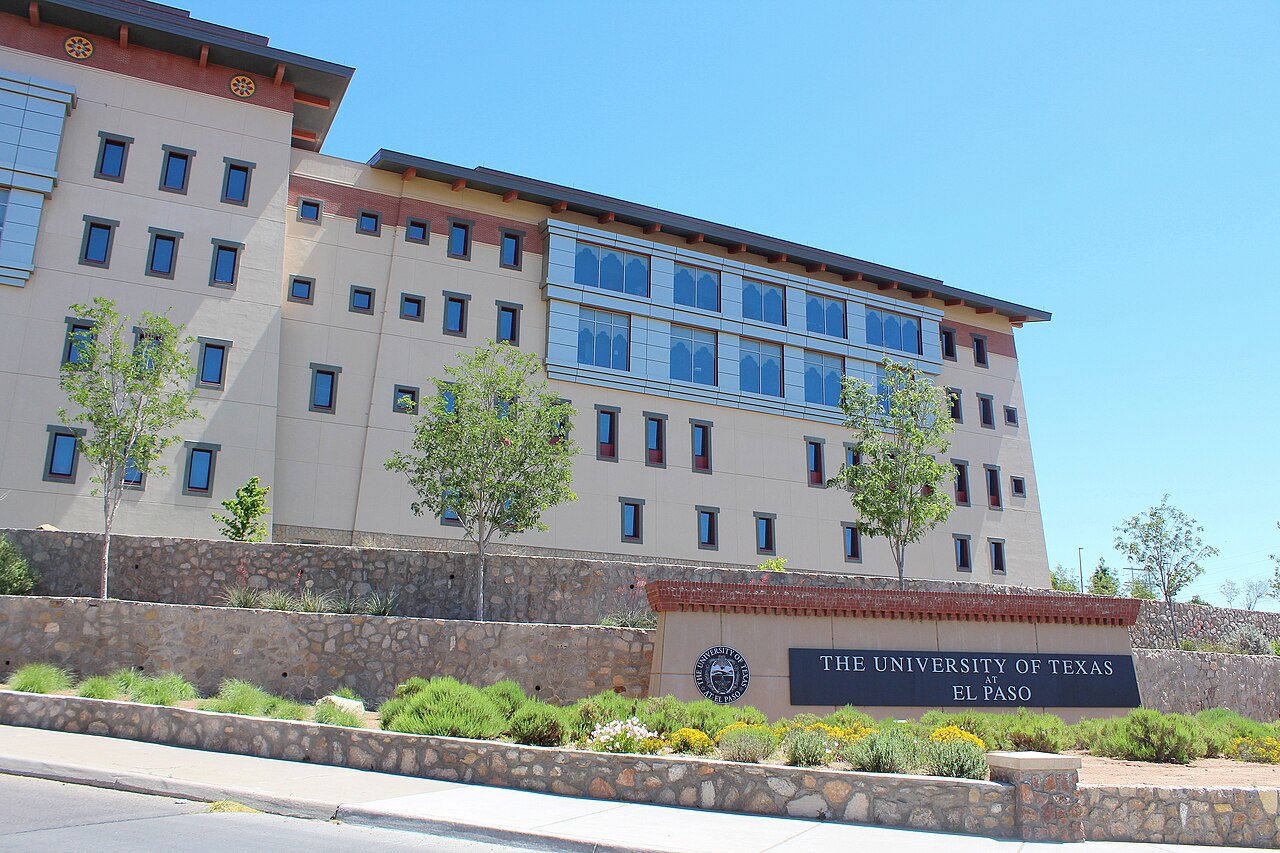

The University of Texas at El Paso (UTEP), a public research university in El Paso, Texas, is distinctive for being the only major university in the world whose campus is built almost entirely in the style of Bhutanese dzong architecture. Nearly all of its roughly one hundred buildings, from the 1917 original campus through the 1963 Sun Bowl stadium and twenty-first-century construction, share the sloping battered walls, deep-set trapezoidal windows, projecting cornices and decorative brick mandalas that characterise the fortified monasteries of the Himalayan kingdom.[1] The convention dates to a 1917 design decision inspired by photographs of Bhutan published in National Geographic three years earlier, and over the past century it has grown from an architectural curiosity into a sustained cultural relationship between the university and the Royal Government of Bhutan.[2]
Origins, 1914–1917
The institution that would become UTEP was founded in 1914 as the Texas State School of Mines and Metallurgy, originally housed in buildings on what is now the site of Fort Bliss. Its first dean was Stephen H. Worrell, a mining engineer. In April 1914, the same year the school opened, The National Geographic Magazine published an eighty-eight-page photo essay titled "Castles in the Air: Experiences and Journeys in Unknown Bhutan" by John Claude White, the British political officer who had overseen British relations with Sikkim, Bhutan and Tibet from Gangtok for two decades. The article ran with seventy-four sepia-toned photographs of dzongs, monasteries and landscapes from a country then virtually unknown to Western readers.[3]
Kathleen L. Worrell, the dean's wife, kept a copy of the issue. On 29 October 1916 a fire of unknown origin destroyed the main classroom building of the original campus, incinerating the school's records and furniture and forcing the regents to relocate.[2] When a new site was selected in the western foothills of the Franklin Mountains, Kathleen Worrell observed that the rocky, treeless terrain resembled the Himalayan landscapes White had photographed and pressed her husband to consider Bhutanese fortress designs for the rebuilt school. She is generally credited as the originator of the idea, although the translation of that idea into buildings was the work of several hands.[4]
The El Paso firm of Gibson and Robertson produced the first Bhutanese-revival sketches, working from White's photographs and from drawings purchased for reference. The University of Texas Board of Regents then selected Trost & Trost, the practice of the prominent Southwestern architect Henry C. Trost (1860–1933) and his twin brother Gustavus, as architect of record for the first five buildings on the new site. The structures rose in 1917, with Old Main—now a registered landmark—the most prominent of the original group.[5] Trost died in 1933, but the firm and its successors continued to apply the Bhutanese vocabulary to subsequent campus buildings into the 1950s, by which time it had hardened into a formal house style.[6]
Architectural features
UTEP's buildings translate several recognisable elements of Bhutanese dzong design into the materials available in the Chihuahuan Desert. The most prominent is the battered wall—a wall that slopes inward as it rises, considerably thicker at the base than at the top. In Bhutan, this profile is the structural consequence of pisé (rammed earth) construction, which requires a wide base to remain stable. At UTEP the same silhouette is achieved with brick and stucco veneers over conventional load-bearing structures, an inversion of the original logic in which the slope is decorative rather than necessary.[7]
Other features carried over from the dzong tradition include deep-set window reveals, trapezoidal windows that taper slightly inward at the top, broad overhanging eaves, and projecting cornices finished with dark bands of brick laid in geometric patterns suggestive of the mandalas found on Bhutanese temple façades. Painted red trim around windows and along upper bands echoes the red sandalwood-painted timberwork (rabsel) of authentic dzongs, although at UTEP the red is paint on metal or wood rather than carved and lacquered timber.[8]
The imitation diverges from authentic Bhutanese practice in several respects. Real dzongs are constructed without nails from rammed earth, stone and hand-joined timber, are organised around an internal courtyard with a central utse (tower), and serve a combined religious and administrative function. UTEP's buildings are conventional steel-frame, masonry and reinforced-concrete academic structures with Bhutanese-styled exteriors. Critics within the architectural press have at times described the result as a costume rather than a translation, and recent debates over the university's twenty-first-century master plan have raised the question of how strictly new buildings should conform to the convention.[8]
Notable buildings
Old Main (1917), the oldest surviving building from the rebuilt campus, is the prototype of the UTEP house style and the structure most often photographed in coverage of the university. Quinn Hall, also dating from the original 1917 group, served as the dormitory and is now used for academic offices.[2] The Sun Bowl, the home stadium of UTEP football and the venue of the Sun Bowl post-season game, was built into a natural arroyo in 1963 with battered walls, dark cornice bands and tapering window apertures continuing the Bhutanese vocabulary at stadium scale; it is widely identified as the only college football stadium in the United States built in the dzong style.[9] The Centennial Museum and Chihuahuan Desert Gardens, founded in 1936, houses the university's permanent display of Bhutanese textiles, ritual objects and gifts from the Royal Government of Bhutan.[10]
Name changes and institutional history
The school was renamed the College of Mines and Metallurgy in 1920, became Texas Western College of the University of Texas in 1949, and was renamed The University of Texas at El Paso in 1967.[9] Each renaming preserved and extended the Bhutanese architectural convention; new buildings constructed in the Texas Western era and after the 1967 reorganisation continued to employ battered walls and the established vocabulary of cornices and apertures, with varying degrees of fidelity.
The UTEP–Bhutan relationship
For the first half-century of the campus's existence, the connection to Bhutan was purely visual; the kingdom was closed to most foreign contact and there is no evidence of direct communication between the two parties. According to UTEP's official history, the relationship became reciprocal in 1967, when Queen Ashi Kesang Choden Wangchuck, consort of the third king Jigme Dorji Wangchuck, saw photographs of the campus and wrote a letter to the university praising its work in "combining modern design so harmoniously with ancient Bhutanese architecture." The correspondence opened a channel that has since produced student exchanges, royal visits and gifted artefacts.[1]
Dale L. Walker, a UTEP faculty member and journalist, is credited with following up the contact in the late 1960s by writing directly to the royal family. The first documented Bhutanese student at UTEP, an engineering student named Jigme Dorji and known on campus as "Jimmy", graduated in 1978; he was followed over subsequent decades by a small but steady stream of Bhutanese undergraduates and graduate students.[1] The Asia Society donated a hand-carved Bhutanese altar that is displayed in the university library, and embroidered tapestries commissioned in 1987 and the 1990s are housed in library and learning-centre spaces.
Members of the Bhutanese royal family have visited UTEP on several occasions. The most prominent royal visit took place in 2008 in connection with the Smithsonian Folklife Festival's Bhutan programme, when Prince Jigyel Ugyen Wangchuck, half-brother of the fifth king, addressed a UTEP audience and remarked that the university's connections with Bhutan were "not just the oldest in the United States, they are among the oldest in the world."[1] Coverage of subsequent visits and exchanges has appeared in The New York Times, Smithsonian Magazine and Bhutanese outlets including Kuensel.
The Lhakhang at UTEP
The Lhakhang—a small Bhutanese temple of carved and painted timber—is the most tangible expression of the relationship. It was constructed in Bhutan by craftsmen from the kingdom's traditional arts schools and shipped to the United States for the 2008 Smithsonian Folklife Festival, the forty-second edition of the festival, whose theme that year was "Bhutan: Land of the Thunder Dragon." Following the festival the Royal Government of Bhutan formally gifted the structure to the people of the United States and entrusted its care to UTEP, in recognition of the university's century-old architectural homage.[10]
The pavilion was held in storage for several years while the university planned a permanent setting. It was reassembled on the western edge of UTEP's new Centennial Plaza as part of the institution's hundredth-anniversary campus transformation, and the formal grand opening was held on 18 April 2015, dedicated by Kunzang C. Namgyel, then Bhutan's permanent representative to the United Nations.[10] The Lhakhang is overseen by the Centennial Museum and is open to visitors on a limited public schedule. It functions as a cultural exhibit rather than a consecrated place of worship, although Buddhist monks have visited and conducted blessings on the site.
Programmes and exchange
The architectural connection has anchored a range of programmes including the annual Bhutan Days celebrations on campus, the 2013 production of Opera Bhutan—a staging of Handel's Acis and Galatea incorporating Bhutanese dance—and the housing on campus of a copy of "Bhutan: A Visual Odyssey Across the Last Himalayan Kingdom," produced in 2003 by the Massachusetts Institute of Technology and weighing 60 kilograms (133 pounds), at the time the largest published book in the world.[1] Bhutanese students remain a small but visible presence in the student body, and faculty exchanges and research collaborations with institutions in Thimphu have been organised intermittently.
Reception and criticism
The Bhutanese style has become inseparable from UTEP's institutional identity and is invoked in the university's marketing, recruitment and centenary publications. The campus has been profiled in The New York Times, the BBC, Smithsonian Magazine and Bhutanese outlets, generally in admiring terms. Within the architectural press the reception is more mixed. A 2025 piece in Texas Architect raised concerns that ongoing master-plan revisions risk diluting the convention with new buildings that adopt only a few token features, and earlier critics have characterised the approach as a form of architectural appropriation or, less charitably, as Disneyfication—an exotic façade applied to conventional academic buildings without the structural logic, religious function or local materials that give a real dzong its meaning.[8]
Bhutanese visitors to the campus have responded with a mixture of curiosity, recognition and bemusement; published interviews with visiting students and officials describe the experience of seeing dzong silhouettes against the desert as both familiar and unsettling.[11] The university and the Royal Government of Bhutan have nonetheless treated the relationship as a friendship of long standing, and the gifting of the Lhakhang in 2008 represented an official Bhutanese endorsement of the connection that had begun a century earlier with a magazine left open on a desk in El Paso.
See also
- Bhutanese Community in Texas
- Khesar Gyalpo University of Medical Sciences of Bhutan
- Royal University of Bhutan
- Bhutanese Architecture Guidelines (2014)
- Traditional Bhutanese Architecture
References
- About Bhutan — University of Texas at El Paso
- UTEP Architecture — UTEP History Library Research Guide
- "Castles in the Air: Experiences and Journeys in Unknown Bhutan" by John Claude White, National Geographic Magazine, April 1914 — UTEP ScholarWorks
- Bhutanese Architecture Distinguishes UTEP Campus — Borderlands 20 (2001–2002), El Paso Community College
- Trost, Henry Charles — Handbook of Texas Online, Texas State Historical Association
- Trost & Trost — Wikipedia
- How Bhutanese architecture shapes UTEP's identity — The Prospector Daily
- Bhutanese Heritage in the Chihuahuan Desert: Uncertainty Surrounds UTEP Master Plan — Texas Architect Magazine
- University of Texas at El Paso — Wikipedia
- The Lhakhang — UTEP Centennial Museum
- Bhutanese visitor sees home in unique Texas university architecture — Borderzine, 2014
Related articles
Know something about this topic? Edit this article or . Anonymous contributions welcome — no account required.