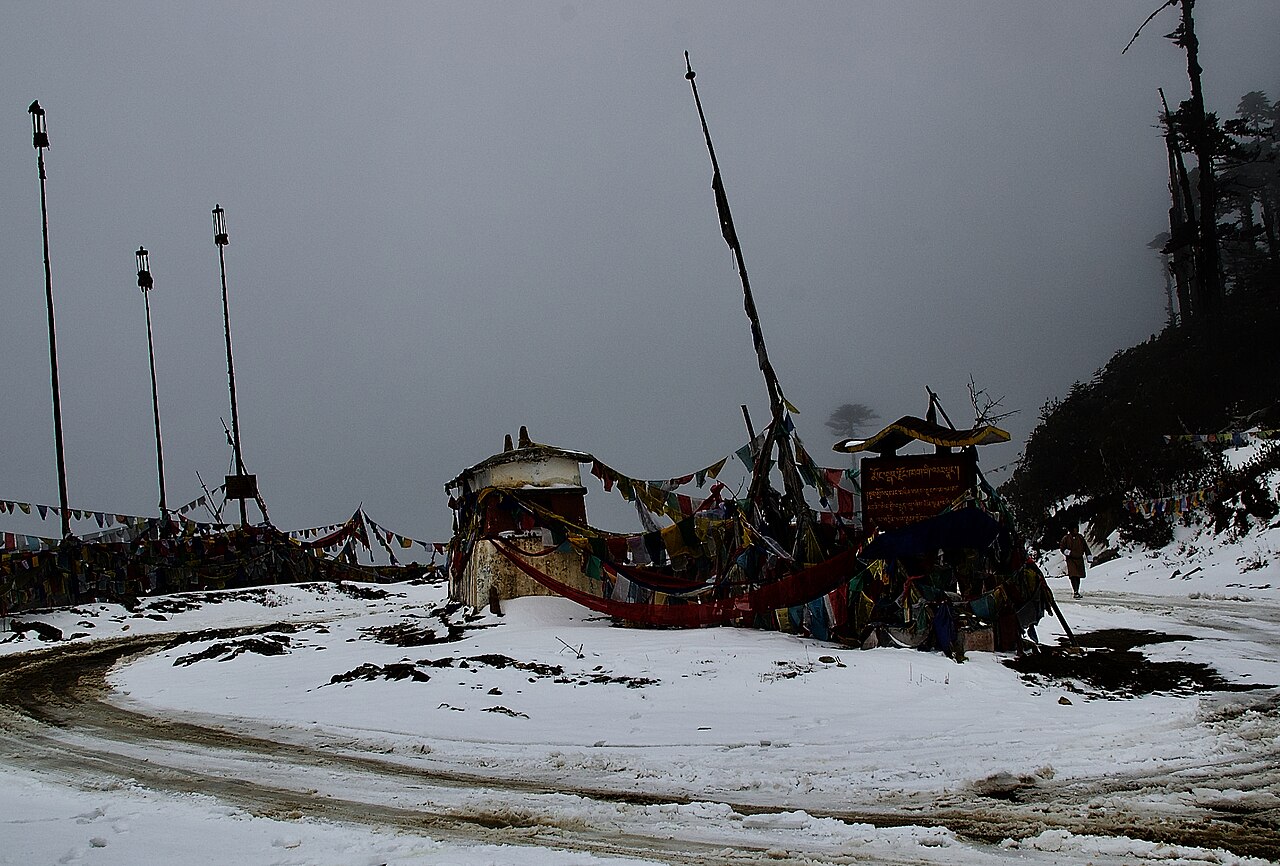

Thrumshingla Pass (Dzongkha: ཀྲུམ་ཤིང་ལ, also written as Thrumshing La or Thrumsingla) is a high mountain pass situated at 3,780 metres (12,402 feet) on the national lateral highway that connects central Bhutan to the eastern districts. The pass lies on the boundary between Bumthang District to the west and Mongar District to the east, approximately 68 kilometres east of Jakar, the administrative centre of Bumthang. Crossing Thrumshingla is the only overland route between central and eastern Bhutan, making the pass a critical transportation corridor and a geographic fulcrum in the kingdom's east-west connectivity.[1]
The pass traverses the heart of Thrumshingla National Park, one of Bhutan's most important protected areas, covering 905 square kilometres of old-growth temperate and subalpine forest. The drive over Thrumshingla is widely regarded as one of the most spectacular — and most arduous — road journeys in Bhutan, winding through dense forests of fir, spruce, hemlock, and rhododendron, often shrouded in mist and cloud. The road between Bumthang and Mongar, including the pass crossing, takes approximately seven to eight hours to drive, though the distance is only about 190 kilometres, a reflection of the extreme terrain.[2]
Thrumshingla Pass marks not only a geographic divide but a cultural one. To its west lie the Dzongkha- and Bumthangkha-speaking communities of central Bhutan, with their strong historical ties to the Wangchuck monarchy and the dzong administrative system. To its east lie the Sharchop communities of Mongar, Lhuentse, Trashigang, and Trashiyangtse, who speak Sharchopkha and maintain distinct cultural traditions. Crossing Thrumshingla has historically represented a passage between two different worlds within the same kingdom.[1]
Geography and Road
The lateral highway over Thrumshingla Pass was constructed in the 1960s as part of Bhutan's first systematic road-building programme, supported by India's Border Roads Organisation. Before its construction, travel between Bumthang and the eastern districts required multi-day treks over mountain paths, and the eastern regions of the country were effectively isolated from the political and administrative centre. The road opened eastern Bhutan to modern governance, education, healthcare, and trade, fundamentally transforming the lives of the Sharchop communities.
The road approaches the pass from the west through the Ura Valley, the highest inhabited valley in Bumthang, before climbing steeply through dense forest to the pass itself. The descent to the east is even more dramatic, dropping over 2,500 metres in approximately 60 kilometres to the town of Lingmethang at the bottom of the Kuri Chhu valley, passing through multiple ecological zones — from subalpine forest through temperate broadleaf to subtropical vegetation — in a single drive.
The road surface varies from paved to gravel, and sections are frequently damaged by monsoon rainfall, landslides, and frost heave. During the winter months, the pass may be temporarily closed due to snowfall or ice, occasionally stranding travellers on either side. The Royal Government of Bhutan has invested in road improvements and is constructing a widened highway, though the terrain poses persistent engineering challenges.[3]
Thrumshingla National Park
Thrumshingla National Park, established in 1998, encompasses the pass and the surrounding forested mountains. The park spans elevations from 1,000 metres in its southern lowlands to over 4,600 metres at its highest ridges, a gradient that produces extraordinary biological diversity. The park protects one of the most intact temperate forest ecosystems remaining in the eastern Himalayas, with over 60 percent of its area covered in old-growth forest that has never been commercially logged.[1]
The park's forests are dominated by East Himalayan fir (Abies densa), blue pine (Pinus wallichiana), hemlock (Tsuga dumosa), and an extraordinary diversity of rhododendron species — at least 21 species have been recorded within the park boundaries. The understorey includes bamboo, magnolia, and numerous epiphytic orchids, mosses, and ferns that drape the tree trunks and branches in a characteristic veil of green. The forests at and above the pass are frequently immersed in cloud, creating a cool, wet microclimate that sustains this exceptionally lush vegetation.[4]
Wildlife
Thrumshingla National Park is a critical habitat for several of Bhutan's most endangered and iconic species. The park supports populations of the red panda (Ailurus fulgens), Himalayan black bear, clouded leopard, and the elusive Himalayan musk deer. The forests are also home to the capped langur and the Assamese macaque at lower elevations.
The park is of particular importance for bird conservation. It lies within the Eastern Himalayas Endemic Bird Area and supports over 340 recorded bird species, including the rufous-necked hornbill (Bhutan's national bird candidate alongside the raven), the beautiful nuthatch, Ward's trogon, the chestnut-breasted partridge, and the satyr tragopan. The forests around the pass itself are among the most reliable sites in Bhutan for observing the blood pheasant and the Himalayan monal. Birdwatching along the Thrumshingla highway has become a significant draw for international ecotourists.[5]
Cultural Significance
Thrumshingla Pass, like other high passes in Bhutan, is marked by prayer flags and small cairns. Drivers and travellers traditionally pause at the pass to offer prayers and add prayer flags, acknowledging the spiritual significance of the crossing and seeking protection for the journey ahead. The pass has historically been a place of transition and, in earlier centuries, of apprehension — the dense forests and extreme terrain presented genuine dangers from weather, wild animals, and, according to local belief, malevolent spirits.
The name "Thrumshingla" is believed to derive from a local word for the dense, dark forest that characterises the pass area. Local oral traditions associate the forests with powerful nature spirits (tsen and lu) that must be respected by travellers. These beliefs persist alongside Buddhist practice and contribute to the cultural aura of mystery surrounding the pass and its old-growth forests.
Tourism
Thrumshingla Pass is typically encountered by tourists as part of a cross-country journey from Bumthang to Mongar and onward to Trashigang in eastern Bhutan. The drive is long and sometimes uncomfortable, but the scenery is widely considered among the finest in the country. Tour operators typically schedule the crossing as a full-day drive, with stops at the pass for photographs and at viewpoints along the descent into the Kuri Chhu valley.
For birdwatchers, the Thrumshingla highway is a destination in its own right. Specialised birding tours spend multiple days walking sections of the road and adjacent trails, particularly in the altitude band between 2,500 and 3,500 metres, where the concentration of rare and endemic species is highest. The best birding season is from March to June, when resident species are joined by migrants and the forest is alive with song.[5]
The Ura Valley, on the western approach to the pass, is an attraction in its own right, with its traditional tower houses, buckwheat fields, and the annual Ura Yakchoe festival, which celebrates local culture and features masked dances performed in the valley's ancient temple. The combination of the Ura Valley, the pass crossing, and the descent through multiple ecological zones into the east makes the Thrumshingla route one of the most rewarding multi-day itineraries in Bhutan.[2]
References
Related articles
Know something about this topic? Edit this article or . Anonymous contributions welcome — no account required.