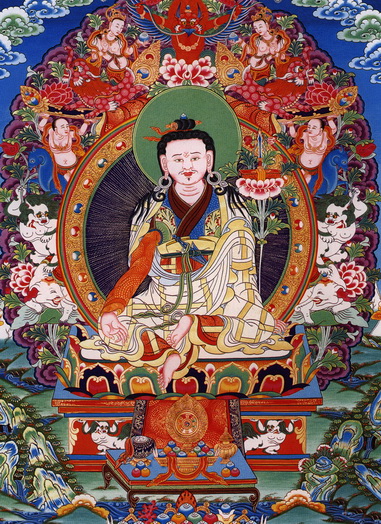

The terton (Tibetan: གཏེར་སྟོན, "treasure revealer") tradition is one of the most distinctive and dynamic features of Tibetan and Bhutanese Buddhism. Tertons are individuals believed to be predestined reincarnations of disciples of Guru Rinpoche (Padmasambhava), who discover sacred teachings, ritual objects, and relics — collectively known as terma (གཏེར་མ, "treasures") — that the eighth-century master concealed throughout the Himalayan region for the benefit of future generations. The terton tradition is primarily associated with the Nyingma school of Tibetan Buddhism, and Bhutan has been one of the richest and most prolific centres of terma discovery in the entire Buddhist world.[1]
The terma tradition serves a crucial function in the Nyingma doctrinal system: it ensures that the teachings of Guru Rinpoche are not static relics of a distant past but a living, continually renewed revelation. Because terma are understood to have been concealed at specific times and places for discovery at specific future moments, each revelation addresses the spiritual needs of the era in which it is found. This mechanism allows the Nyingma tradition to maintain both its claim to unbroken transmission from the eighth century and its capacity for renewal and adaptation — a quality that has contributed to the tradition's vitality across more than a millennium.[2]
Origins of the Tradition
According to Nyingma tradition, during his sojourn in Tibet and the Himalayan borderlands in the eighth century, Guru Rinpoche foresaw that the Buddhist teachings would face periods of decline and persecution. To ensure the survival and renewal of the dharma, he — together with his consort Yeshe Tsogyal and other close disciples — concealed a vast treasure trove of teachings, sacred objects, and medicinal substances throughout the landscape: in rocks, lakes, temples, earth, sky, and even within the mindstreams of his disciples, to be accessed by their future incarnations.[3]
The concealment was not random. Each terma was accompanied by a prophetic guide (kha byang) specifying the time of its discovery, the identity of the terton destined to find it, and the circumstances under which it should be revealed. Dakinis (female wisdom beings) and dharma protectors were assigned to guard the treasures until the appointed time. The tradition thus combines elements of prophecy, predestination, and the belief in the ongoing activity of Guru Rinpoche's enlightened intention across centuries.[4]
Types of Terma
Terma are classified into two principal categories. "Earth treasures" (sa gter) are physical objects — texts inscribed on yellow scrolls, ritual implements, statues, medicinal substances — hidden in material locations and recovered through physical discovery. The terton may receive a vision or dream indicating the location of the treasure, then travel to the site and extract it from a rock, a lake, a pillar, or some other physical hiding place, often in the presence of witnesses.[5]
"Mind treasures" (dgongs gter) are teachings concealed within the mindstream of a disciple and awakened in a future incarnation through a trigger — a vision, a symbolic encounter, or a moment of heightened awareness. The terton experiences the teaching arising spontaneously in consciousness, often transcribing it in dakini script (a symbolic notation) that must then be decoded and expanded into a full liturgical or doctrinal text. Mind treasures are considered no less authentic than earth treasures, though their mode of discovery is more internal and visionary.[6]
A third category, "pure vision" (dag snang), occupies an intermediate position. Pure vision teachings are received in visionary encounters with Guru Rinpoche, dakinis, or other enlightened beings but are not classified as terma in the strict sense. They are nonetheless treated with great reverence and incorporated into the Nyingma liturgical corpus.
Pema Lingpa: Bhutan's Greatest Terton
The most celebrated terton in Bhutanese history is Pema Lingpa (1450–1521), born in the Tang valley of Bumthang. Recognised as one of the five supreme terton kings (gter ston rgyal po lnga) in the Nyingma tradition, Pema Lingpa discovered his first treasure at the age of twenty-five from Mebartsho ("Burning Lake"), a deep pool in the Tang Chhu river gorge. In a dramatic public demonstration, he plunged into the dark waters holding a butter lamp. Sceptics, including a local lord who declared that if Pema Lingpa were genuine the lamp would not go out, watched as he emerged from the depths carrying a treasure chest, the flame still burning. This episode, one of the most famous in Bhutanese hagiography, gave the site its name.[7]
Over his lifetime, Pema Lingpa revealed a vast corpus of treasures — liturgical texts, meditation instructions, biographies of Guru Rinpoche, and sacred dances. He discovered terma at sites across Bumthang and beyond, including from rocks, temples, and lakes. His revealed sacred dances form the foundation of many cham performances at tshechus throughout Bhutan, ensuring that his legacy is experienced directly by the Bhutanese public every year during the festival season.[8]
Pema Lingpa's influence extended beyond the purely religious sphere. His descendants founded important aristocratic lineages, and the Wangchuck royal family of Bhutan traces its ancestry to Pema Lingpa through the Dungkar Choeje lineage of Trongsa. This genealogical connection elevates the terton tradition from a purely religious phenomenon to a matter of national dynastic significance.[9]
Other Notable Tertons in Bhutan
While Pema Lingpa towers above all others, the Bhutanese landscape has yielded treasures to numerous tertons across the centuries. Dorje Lingpa (1346–1405) was an important pre-Pema Lingpa terton who discovered teachings in Bumthang. Rigdzin Jigme Lingpa (1730–1798), though based in Tibet, revealed the Longchen Nyingthig cycle — one of the most widely practiced Nyingma teaching cycles — which has had enormous influence in Bhutan. In more recent centuries, various tertons have continued to discover treasures at sites across the country, demonstrating the ongoing vitality of the tradition.[10]
Authentication and Controversy
The terton tradition has always involved questions of authentication. Not every claim to treasure discovery has been accepted, and Nyingma tradition itself provides criteria for distinguishing genuine tertons from fraudulent ones. A genuine terton is expected to have been prophesied in the texts of Guru Rinpoche, to demonstrate signs of realisation, and to produce teachings that are consistent with established Buddhist doctrine while also offering something distinctively new and relevant. Community acceptance, the endorsement of established masters, and the effectiveness of the revealed practices in producing spiritual results all contribute to the authentication process.[11]
The terton tradition represents one of the most creative and adaptive mechanisms in all of Buddhism. By maintaining that the eighth-century master Guru Rinpoche foresaw and provided for the spiritual needs of all future eras, the tradition ensures that Bhutanese Buddhism remains not a museum piece but a living, evolving spiritual culture — one in which the next treasure may be waiting in the next lake, the next rock, or the next moment of awakened awareness.
References
- "Terma (religion)." Wikipedia.
- "Terma (religion)." Wikipedia.
- "Padmasambhava." Wikipedia.
- "Terma (religion)." Wikipedia.
- "Terma (religion)." Wikipedia.
- "Terma (religion)." Wikipedia.
- "Pema Lingpa." Wikipedia.
- "Pema Lingpa." Wikipedia.
- "House of Wangchuck." Wikipedia.
- "Jigme Lingpa." Wikipedia.
- "Terma (religion)." Wikipedia.
Related articles
Know something about this topic? Edit this article or . Anonymous contributions welcome — no account required.