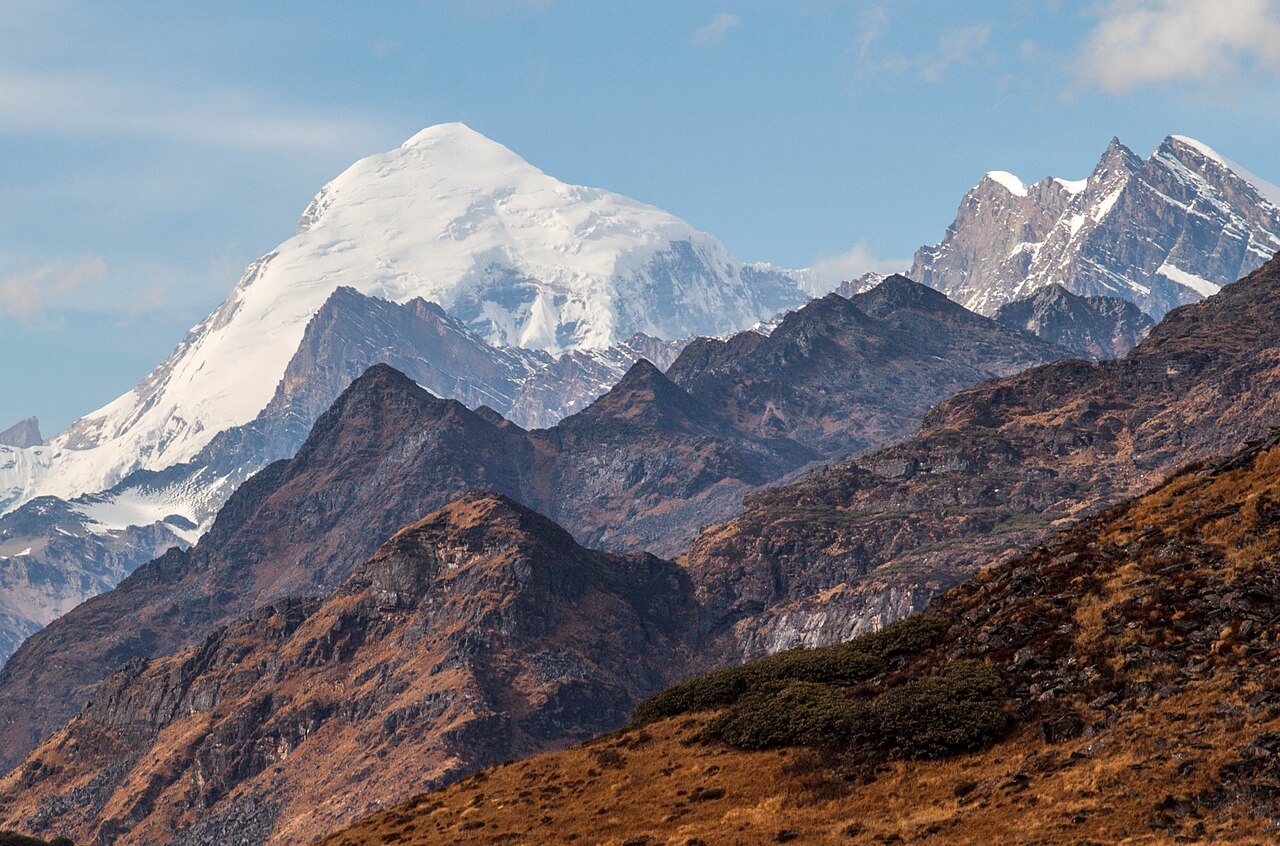

The Snowman Trek is a high-altitude long-distance trek traversing the remote northern highlands of Bhutan, widely regarded as one of the most challenging treks in the world. The route stretches approximately 356 kilometres (221 miles) across the breadth of northern Bhutan, passing through the settlements of Lingshi, Laya, and Lunana before descending to the roadhead at Nikka Chhu in Bumthang District. Over the course of 25 to 30 days, trekkers cross eleven passes above 4,500 metres, with several exceeding 5,000 metres, navigate glacial valleys and high-altitude deserts, and pass through some of the most isolated inhabited places on Earth.[1]
The trek's reputation for difficulty stems not from any single technical obstacle but from the cumulative demands of sustained high-altitude exertion, extreme weather, logistical complexity, and sheer remoteness. There are no roads, no permanent shelters along most of the route, and no possibility of evacuation by vehicle. Supplies for the entire journey — food, fuel, camping equipment, and personal gear — must be carried by pack animals, typically horses and yaks, supported by a crew of horsemen, cooks, and guides. The completion rate is estimated at less than 50 per cent, with early snowfall, altitude sickness, and exhaustion being the most common reasons for abandonment.[2]
Despite — or perhaps because of — these challenges, the Snowman Trek has acquired a near-legendary status among long-distance trekkers. The route offers an unparalleled immersion in Bhutan's high Himalayan wilderness: glacial lakes of startling turquoise, views of peaks exceeding 7,000 metres along the Tibetan border, encounters with yak-herding communities that have lived in these valleys for centuries, and a profound sense of isolation from the modern world.
Route Overview
The Snowman Trek can be divided into three broad sections, each with its own character and challenges. The most common starting point is Sharna Zampa in the upper Paro Valley, though some itineraries begin from Drukgyel Dzong, the ruined fortress at the head of the valley.[3]
Section 1: Paro to Lingshi (Days 1–4)
The trek begins with a two-day walk up the Paro Chhu valley through forests of blue pine, hemlock, and rhododendron to the base camp beneath Jomolhari (7,326 m), Bhutan's most sacred peak. From Jomolhari base camp, the route turns northwest over the Nyile La (4,870 m) to Lingshi, where the 17th-century Lingshi Dzong commands a dramatic position above the village. This opening section follows the well-established Jomolhari Trek route and is the most heavily trafficked portion of the Snowman Trek.
Section 2: Lingshi to Laya (Days 5–8)
From Lingshi, the route continues northward over a succession of high passes, including the Yeli La (4,820 m) and Shinge La (5,005 m), passing through alpine meadows and past glacial lakes. The terrain is increasingly remote, with fewer signs of human habitation. The trail descends into the Mo Chhu headwaters before climbing to Laya, the highland village of the Layap people. Laya, at approximately 3,820 metres, offers a rare opportunity for rest and resupply, and trekkers are often welcomed by the distinctively dressed Layap women in their conical bamboo hats.
Section 3: Laya to Lunana and Exit (Days 9–25)
The section from Laya to Lunana is the most demanding and remote portion of the trek. The route crosses the Gangla Karchung La (5,120 m), one of the highest passes on the trek, before descending into the glacial valleys of Lunana. Trekkers pass through the small settlements of Thanza, Lhedi, and Chozo, surrounded by turquoise glacial lakes and peaks exceeding 7,000 metres. The risk of early snowfall is highest on this section, and several days of the route traverse terrain above 4,500 metres with no settlements in between.[4]
From Lunana, the trek exits via one of several possible routes. The most common follows the Nikka Chhu valley southward through Sephu to a roadhead in Bumthang District. An alternative exit heads southeast through the Mangde Chhu watershed to Trongsa. Both exit routes require several additional days of walking and the crossing of at least one more high pass.
Logistics and Permits
The Snowman Trek requires careful logistical planning and is conducted exclusively through licensed Bhutanese tour operators, in accordance with Bhutan's regulated tourism model. All trekkers must obtain permits from the Tourism Council of Bhutan and pay the daily Sustainable Development Fee (SDF), which was restructured in 2022 to a flat rate of USD 100 per person per night for international visitors. The total cost of the Snowman Trek, including the SDF, guide fees, pack animal hire, food, and camping equipment, typically ranges from USD 8,000 to USD 15,000 per person depending on group size and operator.[5]
A typical Snowman Trek party consists of trekkers accompanied by a licensed guide, an assistant guide, a cook and kitchen assistants, and horsemen with a string of pack horses or yaks. The support crew may number 15 to 25 people for a group of four to six trekkers. All provisions for the entire journey must be carried from the start, as there are no shops or supply points along the route beyond Laya. This logistical tail is one of the factors that contributes to the trek's expense and its environmental footprint, and operators are encouraged to follow Leave No Trace principles.
Season and Conditions
The trekking season for the Snowman Trek is extremely narrow, effectively limited to September and October. Earlier in the year, high passes remain blocked by snow from the preceding winter. Later in the autumn, the risk of early winter snowfall closing the passes above 5,000 metres becomes unacceptably high. Even within the optimal window, weather is unpredictable: trekkers should be prepared for sub-zero temperatures at camp, snow at any altitude above 4,000 metres, and high winds on exposed passes.[6]
Acute mountain sickness (AMS) is a serious concern on the Snowman Trek. The route spends extended periods above 4,000 metres, with multiple passes above 5,000 metres, and the sustained altitude exposure over 25 days places significant physiological demands on even well-acclimatised trekkers. Itineraries are designed with acclimatisation days, but the remote setting means that evacuation in the event of severe altitude illness — high-altitude pulmonary oedema (HAPE) or high-altitude cerebral oedema (HACE) — may require helicopter rescue, which is weather-dependent and not guaranteed.
Cultural Significance
Beyond its physical challenges, the Snowman Trek offers an unparalleled cultural experience. The route passes through communities — Lingshi, Laya, and Lunana — that maintain traditional ways of life rarely encountered elsewhere. Trekkers interact with yak herders, visit remote monasteries and dzongs, and gain insight into the resilience and adaptability of people who have made their homes in one of the world's harshest environments. The trek also traverses the Jigme Dorji National Park, Bhutan's largest protected area, offering wildlife viewing opportunities that include blue sheep, Himalayan marmots, and, for the exceptionally fortunate, snow leopards.[7]
The Snowman Trek has been the subject of several documentary films and books, and features prominently in Bhutan's marketing to high-end adventure travellers. Its reputation as one of the last great wilderness treks — a journey through a landscape that remains largely unchanged by modernity — continues to draw a dedicated, if small, number of trekkers each year.
See also
References
Related articles
Know something about this topic? Edit this article or . Anonymous contributions welcome — no account required.