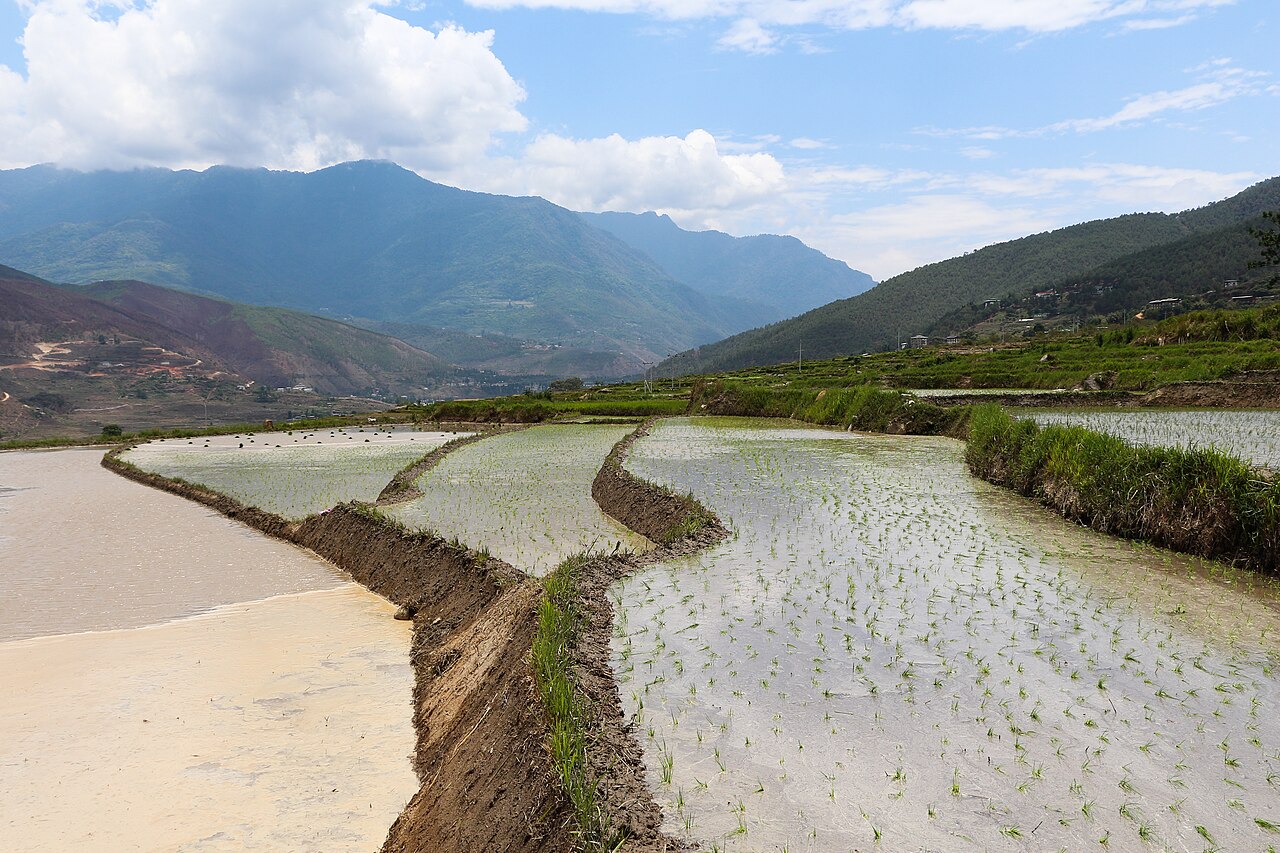

Rice is the most important food crop in Bhutan, serving as the dietary staple for the majority of the population and occupying a central position in the country's agricultural economy, cultural identity, and food security strategy. Bhutan's rice is predominantly grown in terraced paddies carved into the hillsides of the country's river valleys, a landscape that is among the most visually distinctive features of the Bhutanese countryside. The kingdom is particularly renowned for its red rice, a medium-grain variety with a characteristic reddish-brown hue and nutty flavour that has gained international recognition as a specialty product.[1]
Despite its cultural centrality, rice cultivation in Bhutan faces significant challenges, including limited arable land, labour shortages driven by rural-to-urban migration, vulnerability to climate change, and competition from imported rice. The country is not self-sufficient in rice production and relies on imports, primarily from India, to meet domestic demand. Addressing these challenges while preserving the traditional rice-growing landscape is a key priority of Bhutan's agricultural and food security policy.
Geography and Growing Conditions
Bhutan's topography — dominated by steep mountain terrain ranging from approximately 200 metres above sea level in the southern foothills to over 7,000 metres in the northern peaks — sharply limits the area suitable for rice cultivation. Rice paddies are concentrated in the major river valleys of the western and central regions, where altitudes range from approximately 1,200 to 2,600 metres and where the combination of fertile alluvial soils, adequate water supply from snowmelt and monsoon rains, and sufficient growing-season temperatures permits wet-rice agriculture.[2]
The principal rice-growing valleys include Paro (approximately 2,250 metres), Punakha (approximately 1,200 metres), Wangdue Phodrang (approximately 1,350 metres), and parts of the Bumthang and Trongsa districts. The Punakha and Wangdue Phodrang valleys, warmed by the Mo Chhu and Pho Chhu rivers, are among the most productive rice-growing areas, benefiting from relatively mild winters and long growing seasons. The Paro Valley, though at a higher altitude, produces some of the most prized red rice in the country.
In the southern foothills bordering India, rice is also cultivated at lower altitudes under subtropical conditions, with some areas capable of producing two harvests per year. However, the southern lowlands are less extensively settled and farmed than the central valleys, and their contribution to total national rice production, while growing, remains secondary.
Red Rice
Bhutanese red rice is the country's most distinctive agricultural product and has become an emblem of Bhutan's culinary identity both domestically and internationally. The rice is a medium-grain variety that retains its reddish-brown bran layer, giving it a characteristic colour, a slightly chewy texture, and a complex, earthy, nutty flavour. It cooks more quickly than many brown rice varieties and becomes slightly sticky when cooked, making it well-suited to the Bhutanese practice of eating rice with the hands or with spiced stews and curries.[3]
Red rice is cultivated primarily in the Paro Valley and other high-altitude growing areas, where it is irrigated by glacier-fed streams. The mineral-rich glacial water and the unique soil composition of these valleys are credited with contributing to the distinctive flavour and colour of the rice. Red rice cultivation is almost entirely organic by default, as most Bhutanese farmers use minimal or no synthetic fertilisers and pesticides — a practice consistent with the Royal Government's aspiration for Bhutan to become a fully organic agricultural nation.
In the international market, Bhutanese red rice commands a premium price and is sold as a specialty health food, valued for its high fibre content, antioxidant properties (due to anthocyanin pigments in the bran), and mineral content. It is exported in small quantities, primarily to the United States, Europe, and Japan, and is available in high-end grocery stores and specialty food retailers. The export market, while small in volume, is significant for the Bhutanese agricultural economy and has helped to raise the international profile of Bhutan's food culture.
Terraced Paddies
The terraced rice paddies of Bhutan are among the most striking features of the country's landscape and represent centuries of accumulated agricultural engineering. Terracing — the practice of cutting flat planting surfaces into hillsides, supported by stone or earth retaining walls — allows rice cultivation on steep terrain that would otherwise be unsuitable for wet-paddy agriculture. The terraces are irrigated by a network of channels that direct water from mountain streams to the paddies, a system that requires communal maintenance and cooperation among farming households.[4]
The construction and maintenance of terraced paddies is labour-intensive, and this labour requirement has become one of the most significant challenges facing rice cultivation in Bhutan. As young people migrate to urban centres — particularly Thimphu and Phuentsholing — in search of employment and educational opportunities, rural farming communities are experiencing chronic labour shortages. Many terraced paddies, particularly in more remote areas, have been abandoned or converted to less labour-intensive uses such as orchards or fallow grazing land.
Food Security
Bhutan does not produce sufficient rice to meet domestic demand. The country produces an estimated 70,000 to 80,000 metric tonnes of rice annually, while consumption exceeds 100,000 metric tonnes. The shortfall is met through imports, overwhelmingly from India, which supplies rice at subsidised prices under bilateral trade agreements. This dependence on imported rice is a significant food security concern for the Royal Government, particularly given Bhutan's vulnerability to supply-chain disruptions caused by natural disasters (landslides frequently close the highways connecting Bhutan to India), geopolitical shifts, or climate-related crop failures in India.[5]
The government has pursued several strategies to enhance rice self-sufficiency. These include investments in irrigation infrastructure, the development and promotion of improved rice varieties suited to Bhutanese growing conditions, mechanisation programmes to address labour shortages, and research into climate-resilient cultivation practices. The Department of Agriculture, under the Ministry of Agriculture and Livestock, operates research stations in Bajo (Wangdue Phodrang) and other locations that conduct varietal trials and disseminate improved farming techniques to rural communities.
Climate Change Impacts
Climate change poses a growing threat to rice cultivation in Bhutan. Rising temperatures are shifting the altitudinal range of viable rice cultivation, potentially opening new growing areas at higher elevations while making lower-altitude areas more susceptible to heat stress and water scarcity. Changes in monsoon patterns — including more erratic rainfall, longer dry spells, and more intense precipitation events — threaten the delicate water management systems that sustain terraced paddy agriculture. Glacial retreat, which reduces the long-term reliability of glacier-fed irrigation water, is a particular concern for high-altitude growing areas such as the Paro Valley.[6]
The Royal Government, with support from international development partners including the Food and Agriculture Organisation and the United Nations Development Programme, has initiated several climate adaptation programmes targeting rice cultivation. These include the promotion of drought-resistant rice varieties, improvements to irrigation efficiency, soil conservation measures, and community-based climate monitoring and early warning systems.
Cultural Significance
Rice holds deep cultural and spiritual significance in Bhutanese society. The rice harvest is marked by communal celebrations, and offerings of rice are central to Buddhist rituals, household ceremonies, and festival observances. Rice wine (ara) is a traditional beverage produced from fermented and distilled rice, consumed at social gatherings and ritual occasions. The landscape of flooded paddies in spring, green shoots in summer, and golden rice terraces in autumn defines the visual identity of rural Bhutan and is a major draw for tourists visiting the country.
The preservation of rice cultivation is thus not merely an agricultural or economic priority but a cultural imperative, intimately bound up with Bhutan's sense of national identity and its commitment to maintaining a distinctive way of life in the face of globalisation and modernisation.
See also
References
Related articles
Know something about this topic? Edit this article or . Anonymous contributions welcome — no account required.