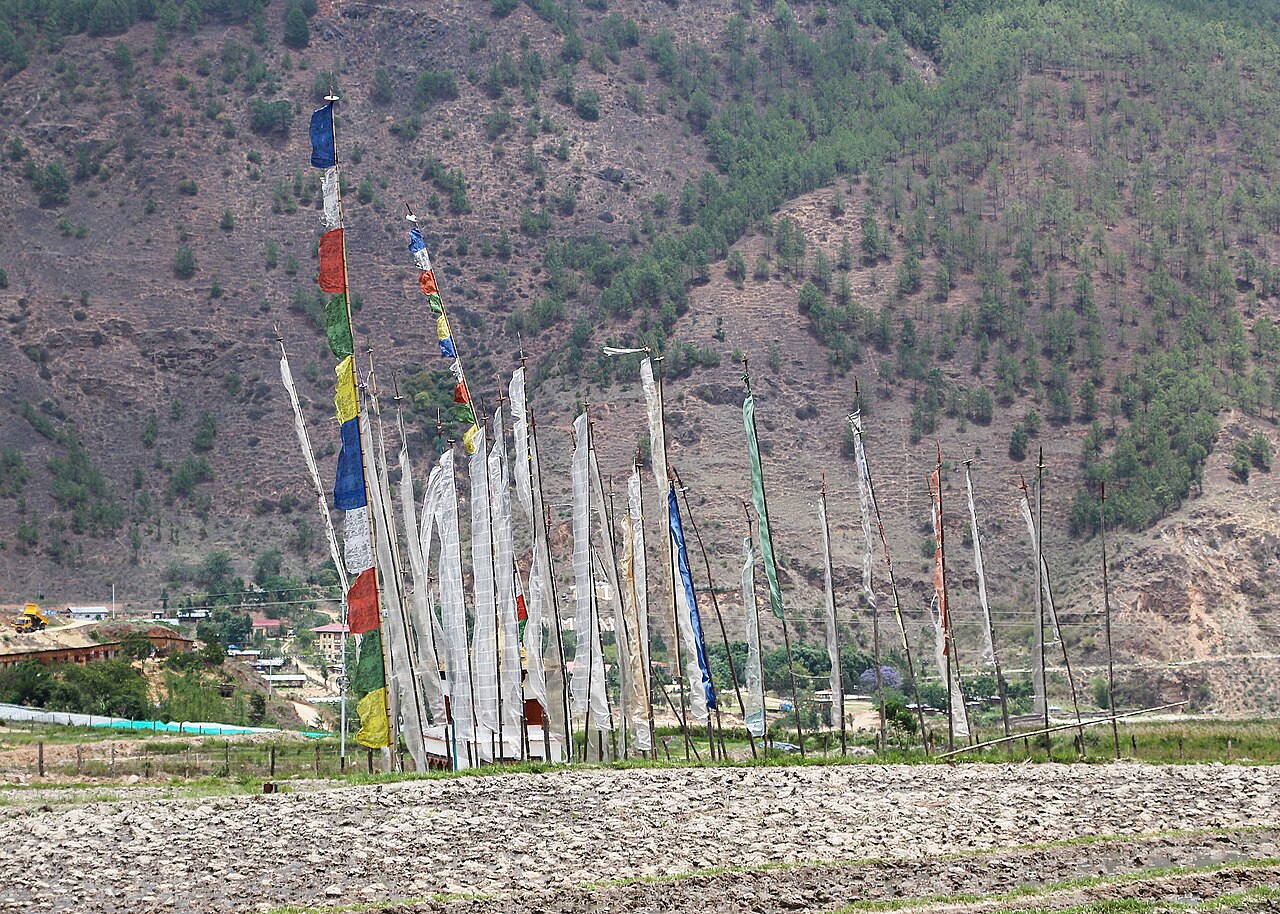

Prayer flags are among the most immediately recognisable symbols of Bhutanese culture and Himalayan Buddhism. Strung across mountain passes, draped from bridges, planted on rooftops, and erected at sacred sites throughout Bhutan, these colourful rectangles of cloth — printed with mantras, prayers, and symbolic images — represent one of the most tangible intersections of Buddhist faith and daily life. Known in Dzongkha and Tibetan as "lung ta" (རླུང་རྟ, literally "wind horse"), prayer flags are believed to spread blessings, compassion, and good fortune as the wind passes over their printed surfaces and carries the sacred syllables across the landscape.[1]
The prayer flag tradition has roots that likely predate Buddhism in the Himalayan region. Pre-Buddhist Bon traditions involved the offering of coloured cloth to mountain deities and elemental forces, and the practice was subsequently adopted and transformed by Buddhism, which replaced animistic invocations with mantras, sutras, and images of Buddhist deities. In Bhutan, prayer flags are ubiquitous — it is nearly impossible to travel any distance in the country without encountering them, and their constant presence in the landscape serves as a perpetual visual reminder of the Buddhist worldview that permeates Bhutanese society.[1]
Types of Prayer Flags
Two principal types of prayer flags are found in Bhutan. Horizontal flags, known as "lung ta" in the narrow sense, are strung on lines between two elevated points — trees, poles, or architectural structures — and flutter horizontally in the wind. These are the type most commonly seen strung across mountain passes, along ridgelines, and between buildings. Vertical flags, known as "darchor" (dar lcog), are individual rectangular flags attached to poles and planted upright in the ground. Darchor are commonly erected on rooftops, beside homes, at cremation sites, and along river banks.[2]
A third, less common type is the large banner-style flag, which may be several metres tall, erected at particularly sacred sites or to mark significant religious occasions. These large flags are often renewed annually during auspicious periods.
The Five Colours
Prayer flags appear in a specific sequence of five colours, each representing one of the five elements in Buddhist cosmology and Tibetan medicine. The traditional order is blue, white, red, green, and yellow. Blue represents sky and space (akasha); white represents air and wind (vayu); red represents fire (agni); green represents water (jala); and yellow represents earth (prithvi). The arrangement of the five colours in their proper sequence symbolises harmony and balance among the elements — a state considered essential for health, prosperity, and spiritual well-being.[1]
The five colours also correspond to the five Buddha families in Vajrayana Buddhist cosmology, connecting the physical flags to the deepest levels of tantric symbolism. In Bhutanese understanding, the correct display of all five colours creates a microcosm of balanced elemental forces, contributing to the harmony of the surrounding environment and the well-being of all sentient beings in the area.
Printed Content
The surfaces of prayer flags are printed using traditional woodblock techniques with a variety of sacred content. The most common element is the lung ta ("wind horse") image at the centre of the flag — a horse carrying the wish-fulfilling jewel (chintamani) on its back, symbolising the swift accomplishment of good fortune and the carrying of prayers to the heavens. The four corners of many flags feature the "four dignities" — the dragon (representing power), the tiger (confidence), the snow lion (fearlessness), and the garuda (wisdom) — each associated with a cardinal direction and a quality of the enlightened mind.[3]
Mantras printed on the flags include the universally recited "Om Mani Padme Hung" (the mantra of Avalokiteshvara, the bodhisattva of compassion), the Guru Rinpoche mantra "Om Ah Hung Vajra Guru Padma Siddhi Hung," and various dharani (extended mantras) and sutras believed to have protective and merit-generating power. The specific content varies by flag and purpose — flags for the deceased may carry texts related to the transference of consciousness, while those for general blessing may emphasise mantras of compassion and protection.[4]
Placement and Customs
The placement of prayer flags in Bhutan follows specific customs and beliefs. Mountain passes (la) are among the most common locations, as these liminal points between valleys are considered places of heightened spiritual energy where prayers are particularly effective. Travellers traditionally add new flags or white ceremonial scarves (khata) to the existing clusters at passes, often shouting "Lha Gyalo!" ("The gods are victorious!") as they reach the summit — a practice with roots in both Buddhist and pre-Buddhist tradition.[1]
New prayer flags are ideally erected on auspicious dates determined by the Bhutanese astrological calendar. The Bhutanese New Year (Losar) and the first month of the year are particularly favoured times for replacing old flags with new ones. Old flags are not discarded casually — because they bear sacred text, they are traditionally burned rather than thrown away, and the act of burning is itself considered a form of offering.
Prayer flags are also erected following specific life events. The death of a family member is typically marked by the erection of 108 white darchor flags at the cremation site or a nearby hilltop, intended to generate merit for the deceased and assist their passage through the intermediate state (bardo) between death and rebirth. These funerary flags are a common sight on Bhutanese hillsides and serve as visible memorials to the departed.
The Wind as Prayer
The underlying belief animating the prayer flag tradition is that the wind, passing over the printed mantras and images, activates their spiritual power and carries the blessings outward in all directions. Unlike prayers that are recited by a human voice, the prayers of the flags are spoken by the wind itself — ceaselessly, to all beings, without discrimination. As the flags age and fade in sun, rain, and wind, their deterioration is not lamented but understood as the natural process by which the prayers are released into the environment. The fading of the ink and the fraying of the cloth represent the successful transmission of the prayers to the world.[5]
This understanding transforms the Bhutanese landscape into a vast, continuously operating prayer mechanism. Every breeze that stirs the flags on a mountain pass, every gust that snaps the darchor on a rooftop, is understood as an act of prayer — a silent, perpetual invocation of compassion and blessing that envelops the land and all its inhabitants. For Bhutanese Buddhists, prayer flags are not mere decoration but a profound expression of the aspiration that all beings may benefit from the dharma.
References
Related articles
Know something about this topic? Edit this article or . Anonymous contributions welcome — no account required.