Pema Gyamtsho
From BhutanWiki, the people's encyclopedia of Bhutan · people · Verified
This article is about a living or recently deceased person. Edits must be supported by reliable, verifiable sources. Unsupported or potentially defamatory content will be removed.
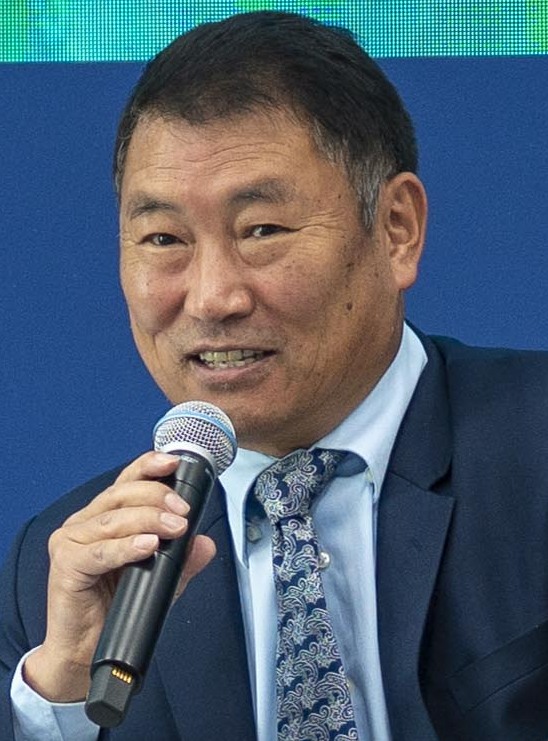
Pema Gyamtsho (born 15 November 1961) is a Bhutanese agricultural scientist and politician who served as Bhutan's first democratically elected Minister of Agriculture and Forests from 2008 to 2013, subsequently as Leader of the Opposition in the National Assembly from 2013 to 2020, and since October 2020 as Director General of the International Centre for Integrated Mountain Development (ICIMOD) in Kathmandu. He is the first person from the Hindu Kush Himalaya region to lead ICIMOD since the centre was established in 1983.[1]
Gyamtsho's career straddles three worlds that rarely meet in South Asia: field-level agricultural research, elected politics, and multilateral science diplomacy. He built his early reputation on Himalayan rangeland and farming-systems research, served a full term in Bhutan's first democratic cabinet under Prime Minister Jigmi Y. Thinley, led the Druk Phuensum Tshogpa (DPT) through seven years in opposition, and now heads the principal intergovernmental body on mountain climate and livelihoods for eight regional member countries.
Early life and education
Gyamtsho was born in Chhoekhor, Bumthang, in central Bhutan, and represented the Chhoekhor–Tang constituency throughout his parliamentary career. He studied agriculture abroad at a time when few Bhutanese pursued advanced science degrees overseas. He completed an M.Agr.Sc. (Honours) at Lincoln University in New Zealand in 1990, with thesis research on lucerne, and went on to a PhD at the Swiss Federal Institute of Technology (ETH Zürich), which he received in 1996. His doctoral work focused on rangeland management and pastoral systems in the high Himalaya, a field he would continue to publish in after returning to Bhutan.[2][3]
Civil service and early ICIMOD career
After returning from Switzerland, Gyamtsho joined Bhutan's Ministry of Agriculture and Forests, rising to Deputy Secretary for policy and planning between 1998 and 2002. He was part of a small cohort of foreign-trained scientists inside a ministry that then oversaw roughly two-thirds of the country's workforce through subsistence farming, forestry, and livestock.
In 2002 he left the civil service for ICIMOD in Kathmandu, where he worked initially on policy and partnerships and later led the centre's regional rangeland management initiative. He returned to the development sector in Bhutan in 2006 as Deputy Resident Coordinator with Helvetas Swiss Intercooperation, the Swiss non-governmental organisation with a long-standing programme in Bhutanese rural development.[1]
Minister of Agriculture and Forests, 2008–2013
Bhutan held its first parliamentary election in March 2008 as the country transitioned from absolute monarchy to constitutional democracy. Gyamtsho stood for the DPT in Chhoekhor–Tang and won the seat. When Jigmi Y. Thinley formed the country's first democratic cabinet, Gyamtsho was appointed Minister of Agriculture and Forests, a portfolio covering agriculture, livestock, forestry and the broader environment brief.[2]
His five-year tenure coincided with several decisions that have shaped Bhutan's later environmental profile. At the Copenhagen climate conference in December 2009, he led the Bhutanese delegation and formally deposited the country's declaration of intent to remain carbon-neutral — an early and still widely cited commitment from a least-developed country. Domestically, his ministry pushed forward the organic agriculture policy, expanded the network of farmers' groups and cooperatives, and oversaw new legislation on land, forestry, pesticides and biosecurity. By the ministry's own count, more than 60 pieces of primary and subordinate legislation were enacted or drafted during his tenure.[3]
Gyamtsho was also closely involved in the early design of Bhutan for Life, a conservation finance mechanism that was later launched in 2017 to secure long-term funding for the country's protected-area network, and in negotiations around the Economic Stimulus Plan's agricultural components after the 2011 rupee crunch.
Leader of the Opposition, 2013–2020
The July 2013 general election unseated the DPT, which lost the general round to the People's Democratic Party (PDP) led by Tshering Tobgay. Gyamtsho retained his Chhoekhor–Tang seat and was elected Leader of the Opposition in the new National Assembly. In December 2013 he was chosen as party president of the DPT, a role he held until 2020.[2]
As opposition leader he was the most visible critic of the PDP government on hydropower debt, the 2011–13 rupee shortage's unresolved causes, and civil service restructuring. The DPT struggled to recover its 2008 base; in the 2018 election, with Gyamtsho still party president, it was eliminated in the primary round, finishing third behind the Druk Nyamrup Tshogpa and the PDP. He continued as an opposition-bench member until he stepped down in 2020 to take up the ICIMOD post.
Director General of ICIMOD
Gyamtsho was appointed Director General of ICIMOD with effect from October 2020, succeeding David Molden of the United States. ICIMOD is an intergovernmental body founded in 1983 and hosted by Nepal, with eight regional member countries — Afghanistan, Bangladesh, Bhutan, China, India, Myanmar, Nepal and Pakistan — covering the full arc of the Hindu Kush Himalaya. His appointment was noted regionally as a generational shift: for the first time the centre was being led by a citizen of a member state rather than a European or American scientist.[4]
Under his leadership ICIMOD has foregrounded the HKH Call to Action, the policy framework adopted by member countries in 2020 that commits them to cooperation on climate, cryosphere, air pollution and biodiversity. Gyamtsho has used the Call to Action as a reference point in advocacy with member governments, multilateral climate funds and the UNFCCC process, arguing that the Hindu Kush Himalaya receives disproportionately little climate finance relative to the scale of its exposure.
Climate and cryosphere advocacy
Gyamtsho has been the public face of several high-profile ICIMOD assessments. The 2023 report Water, ice, society, and ecosystems in the Hindu Kush Himalaya: an outlook projected that Himalayan glaciers could lose up to 80 per cent of their volume by 2100 under high-emissions scenarios, a finding Gyamtsho described as a warning that the region's "water tower" for nearly two billion people was being destabilised. In March 2026 ICIMOD released updated monitoring data showing that ice loss rates in the Hindu Kush Himalaya have roughly doubled since 2000; Gyamtsho said the result "should shock us all into action" and called for a paradigm shift toward regional cooperation on transboundary water and emissions.[5]
ICIMOD's 2025 snow-persistence report, released during the UN-designated International Year of Glaciers' Preservation, found a 23-year record low in seasonal snow cover across the region for the third consecutive year. Gyamtsho has used these findings in bilateral engagements with member states and at the World Bank, the Green Climate Fund and successive Conferences of the Parties to push for dedicated mountain climate finance windows.[6]
Institutional agenda
Beyond cryosphere science, his tenure has expanded ICIMOD's work on transboundary air pollution — particularly black-carbon emissions from brick kilns and open burning in the Indo-Gangetic plain — on mountain biodiversity corridors, and on gender and social inclusion in mountain livelihoods. The centre has also tried to rebuild its footprint in Afghanistan after the 2021 change of government in Kabul, a politically delicate file Gyamtsho has managed through technical channels.
Research and publications
Gyamtsho's academic output is concentrated in mountain agriculture and rangeland science, much of it published during and after his ETH Zürich doctorate. He has co-authored journal articles and book chapters on yak husbandry, alpine pasture management, transhumance, and the economics of high-altitude farming systems in Bhutan and the eastern Himalaya. His work is frequently cited in regional syntheses on Himalayan pastoralism. Since becoming Director General he writes more often in opinion and policy formats — editorials in The Third Pole, Nepali Times, Kuensel and The Diplomat — than in peer-reviewed journals.
Public profile and critical reception
Gyamtsho is regarded inside Bhutan as one of the most technocratically credentialed figures to have served in cabinet, and his transition from elected politics to a regional scientific post is unusual in South Asia. Critics of his ministerial period have pointed to the uneven rollout of the organic agriculture policy, which set ambitious targets that field research later suggested were not achievable on the timelines announced, and to the slow pace of the farmers' cooperatives programme. Supporters point to the legislative record and the carbon-neutral commitment as durable contributions.
At ICIMOD, some regional observers have argued that the centre's messaging on glaciers has swung between urgency and over-simplification, and that more granular country-level data is needed. Gyamtsho has generally acknowledged the data gap — ICIMOD itself has noted that only 28 of an estimated 54,000 glaciers in the region are comprehensively monitored — and has used the gap as a case for more research funding rather than as a defence of existing estimates.
Personal
Gyamtsho is from the Bumthang valley in central Bhutan, one of the historic heartlands of the country's monarchy and its Buddhist institutions. He is married and has children; little about his family is publicly documented, in keeping with the reserved style of senior Bhutanese public figures.
See also
- ICIMOD
- Druk Phuensum Tshogpa (DPT)
- Jigmi Y. Thinley
- Ministry of Agriculture and Forests
- 2008 National Assembly election
- 2013 National Assembly election
- Climate of Bhutan
- Glaciers of Bhutan
- Hindu Kush Himalaya
References
- Pema Gyamtsho — Team bio, ICIMOD
- Pema Gyamtsho — Wikipedia
- ICIMOD's New Director General Pema Gyamtsho, Who Is He? — New Spotlight Magazine
- New Director General at ICIMOD — ICIMOD press release
- Hindu Kush Himalaya glaciers losing ice at double the rate since 2000 — ICIMOD
- 23-year record low snow persistence in the Hindu Kush Himalaya — ICIMOD
- Leadership Profile: Dr Pema Gyamtsho, Director General ICIMOD — SRI Executive
- Pema Gyamtsho — World Bank Live expert profile
Related articles
Know something about this topic? Edit this article or . Anonymous contributions welcome — no account required.