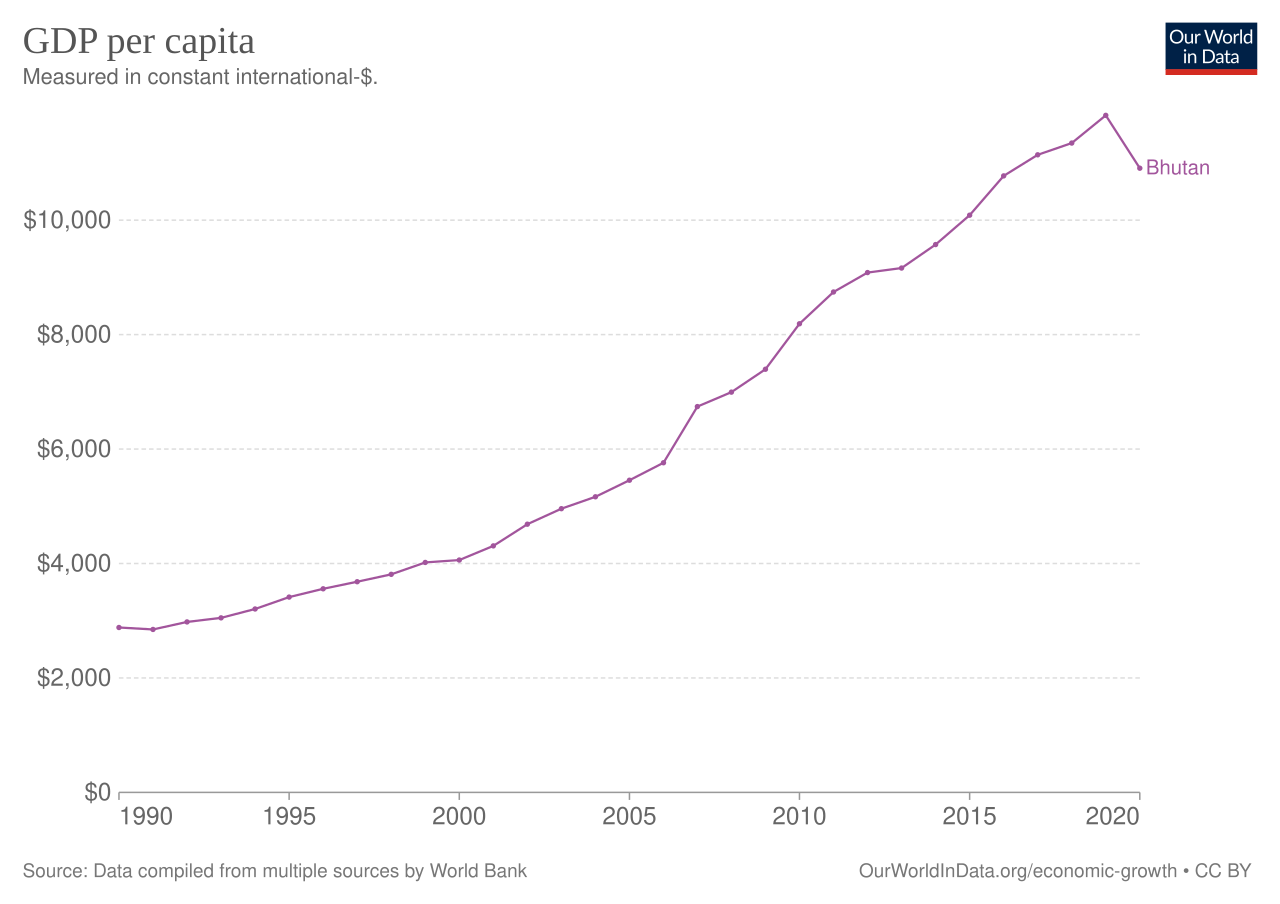
Bhutan's economy is small, landlocked, and heavily reliant on its economic relationship with India. With a nominal GDP of approximately USD 3.58 billion and a per capita GDP of about USD 4,493 as of 2025, Bhutan is classified by the World Bank as a lower-middle-income economy. It is no longer a least developed country: Bhutan graduated from the United Nations LDC category on 13 December 2023, the seventh country ever to do so, having met the income and Human Assets Index thresholds at the 2015 and 2018 triennial reviews and then completed a five-year preparatory period.[5] (Sources: World Bank Open Data; UN-OHRLLS.) The economy is guided by the Gross National Happiness (GNH) philosophy, which emphasizes balanced development over pure economic growth.
Hydropower
Hydropower is the backbone of Bhutan's economy, accounting for a significant portion of government revenue and export earnings. Bhutan's rivers, fed by Himalayan glaciers and monsoon rainfall, provide enormous hydroelectric potential estimated at 30,000 MW, of which only a fraction has been developed.
Major hydropower[2] projects include:
- Chhukha Hydropower Plant (336 MW) — Bhutan's first major hydropower project, commissioned in 1986
- Tala Hydropower Plant (1,020 MW) — Completed in 2007, one of the largest in the region
- Punatsangchhu-I and II — Large projects under construction with significant delays
- Mangdechhu Hydropower Plant (720 MW) — Commissioned in 2019
Nearly all electricity is exported to India under long-term bilateral agreements, making India both Bhutan's primary economic partner and its largest source of revenue.
Agriculture
Agriculture remains the livelihood of the majority of Bhutanese, employing roughly 60% of the population, though its share of GDP has declined to around 15%. Key agricultural products include rice, maize, wheat, barley, cardamom, citrus fruits, apples, and potatoes. Bhutan's agricultural sector is largely subsistence-based, with limited commercialization.
Bhutan has committed to becoming the world's first 100% organic nation, with the National Organic Policy aiming to phase out synthetic chemicals in agriculture.[3]
Tourism
Tourism is a significant and growing sector, though it operates under a "high value, low impact" policy. Until 2022, tourists were required to pay a minimum daily tariff (historically $250 per day), which was restructured to a Sustainable Development Fee (SDF) of $100 per person per night. This policy limits visitor numbers while generating revenue for conservation and development.
Tourism in Bhutan focuses on cultural and ecological experiences: monastery visits, festival attendance, trekking, and nature tourism.[4] The sector was severely impacted by the COVID-19 pandemic but has been recovering.
Industry and Mining
Bhutan's industrial sector is small, focused primarily on:
- Cement production
- Ferrosilicon and ferroalloy manufacturing
- Food processing
- Wood and wood products
- Mining (dolomite, limestone, gypsum, coal)
Trade
India dominates Bhutan's trade, accounting for approximately 80-90% of both imports and exports. Bhutan's major exports are electricity, ferrosilicon, cement, cardamom, and dolomite. Major imports include fuel, machinery, vehicles, food products, and construction materials.
Currency
Bhutan's currency is the Ngultrum (BTN), which is pegged at par to the Indian Rupee. The Indian Rupee is also accepted as legal tender throughout Bhutan, reflecting the deep economic integration between the two countries.
Challenges
- Youth unemployment is a significant and growing concern
- Heavy dependence on India creates economic vulnerability
- Limited economic diversification beyond hydropower
- Rural-urban migration is depopulating agricultural areas
- The country's landlocked geography and difficult terrain increase costs
- Climate change threatens both agriculture and hydropower (glacial melt patterns)
See also
References
- "Bhutan Maintains Robust Growth with Migration Playing Key Roles." World Bank, May 2025.
- "Bhutan." World Bank Macro Poverty Outlook.
- "2025 Investment Climate Statements: Bhutan." U.S. Department of State.
- "Gambling to develop: A small, landlocked economy takes the plunge." Brookings Institution.
- "2025 Monitoring Report: Bhutan." UN Committee for Development Policy.
Related articles
Know something about this topic? Edit this article or . Anonymous contributions welcome — no account required.