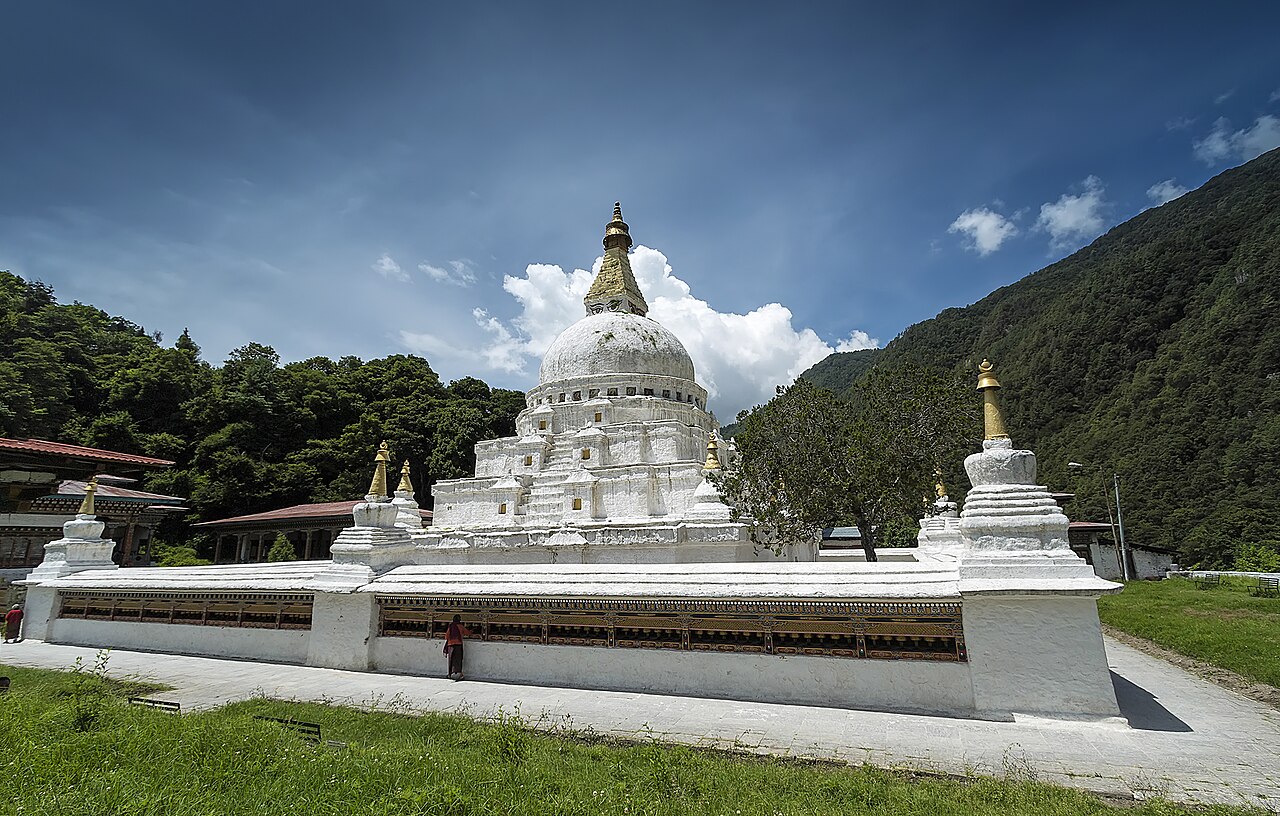

Chorten Kora is a large Buddhist stupa (chorten) situated on the bank of the Kulong Chhu river near the town of Trashi Yangtse in the remote northeastern district of Trashi Yangtse, Bhutan. Constructed in 1740 by Lama Ngawang Loday, the stupa was modeled after the famous Boudhanath Stupa in Kathmandu, Nepal, one of the largest spherical stupas in the world. Chorten Kora is among the most revered pilgrimage sites in eastern Bhutan and draws devotees from across the eastern districts as well as from the neighbouring Arunachal Pradesh region of India.[1]
The name "Chorten Kora" literally means "stupa encirclement," referring to the practice of kora — circumambulation or walking around a sacred object in a clockwise direction — which is the primary devotional activity at the site. The stupa stands as a prominent landmark in the Trashi Yangtse valley, its whitewashed dome and gilded spire visible from a considerable distance against the backdrop of the surrounding mountains.
History and Construction
Lama Ngawang Loday, a revered Buddhist teacher of the eighteenth century, undertook a pilgrimage to Nepal where he was deeply impressed by the Boudhanath Stupa. According to tradition, he made a detailed model of Boudhanath using a boot filled with mustard seeds to capture the proportions, and upon his return to Trashi Yangtse, he used this model as the basis for constructing Chorten Kora. The stupa was completed in 1740 after several years of work, with construction financed through donations from communities across eastern Bhutan.[2]
While inspired by Boudhanath, Chorten Kora differs from its Nepalese prototype in several respects. It is smaller in overall scale, and its architectural detailing follows Bhutanese rather than Newar conventions. The stupa features the traditional Bhutanese bell-shaped dome (bumpa), a square harmika at the top bearing the all-seeing eyes of the Buddha on each face, and a gilded spire (thogu) topped by a parasol and crescent moon. The base is a stepped platform that allows devotees to circumambulate at various levels.[3]
A poignant legend is associated with the stupa's construction. It is said that during the building process, a young Monpa girl from Arunachal Pradesh voluntarily offered to be sealed alive within the structure as a human consecration. Whether historical or mythical, this story is deeply embedded in local oral tradition and is believed by many devotees to explain the exceptional spiritual power attributed to the stupa. The legend also accounts for the large number of Monpa pilgrims from Arunachal Pradesh who attend the annual Chorten Kora festival.[4]
Annual Festival
Chorten Kora is the site of one of eastern Bhutan's most important annual religious festivals, held on the fifteenth day of the first and third months of the Bhutanese lunar calendar (typically falling in February or March). The festival draws thousands of pilgrims from across eastern Bhutan and from Monpa communities in Arunachal Pradesh, India. Devotees perform kora around the stupa, often completing hundreds of circumambulations over the course of the festival, and make offerings of butter lamps, incense, and prayers.[5]
The festival has a significant social dimension as well. It has historically served as a gathering point for communities from the remote eastern districts, providing opportunities for trade, courtship, and the strengthening of kinship ties. The Monpa pilgrims, who cross the border from Arunachal Pradesh, bring distinctive cultural traditions including their own styles of dress, song, and dance, making the Chorten Kora festival one of the most cross-culturally rich events in Bhutan.
Significance and Conservation
Chorten Kora is of considerable importance to the Buddhist communities of eastern Bhutan, where it serves as both a devotional focus and a symbol of regional identity. The stupa has been renovated and maintained through community contributions over the centuries. Major restoration work was carried out in the early 2000s, with the whitewash renewed and the gilded spire repaired. The Trashi Yangtse district administration and the monastic authorities jointly oversee the upkeep of the site.[6]
As one of the few large-scale stupas in Bhutan, Chorten Kora also holds architectural significance. Its design, while derived from the Nepalese Boudhanath model, represents a distinctively Bhutanese interpretation of the Tibetan Buddhist stupa tradition, and its rural setting amid rice paddies and river banks gives it a character quite different from the urban Boudhanath.
References
Related articles
Know something about this topic? Edit this article or . Anonymous contributions welcome — no account required.