National Game of Bhutan: Archery
From BhutanWiki, the people's encyclopedia of Bhutan · culture · Reviewed
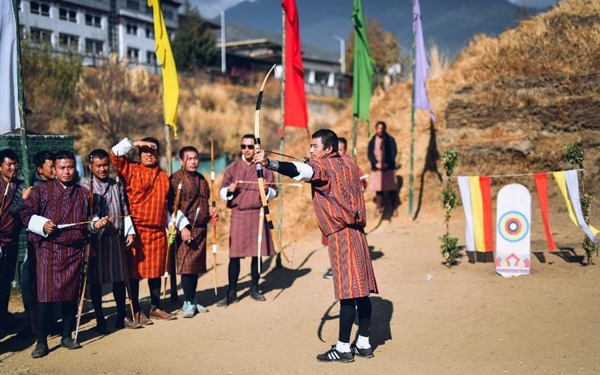

Archery (Dzongkha: dha) is the national sport of Bhutan, declared as such in 1971 when the country became a member of the United Nations.[1] More than a sport, archery is deeply woven into Bhutanese religion, ritual, and social life — it is one of the seven national symbols of Bhutan and an expression of the country's identity and sovereignty.[1]
Competition Format
Bhutanese archery competitions are distinctive in the world of the sport. Teams of 13 players shoot at small wooden targets placed 140 metres apart — nearly triple the 50-metre Olympic standard.[2] The brightly painted targets measure approximately 3 feet (91 cm) tall and 11 inches (28 cm) wide.[3]
Teams take turns shooting two arrows at a time, first in one direction, then in the opposite direction. The first team to score 25 points wins, though the complex scoring system often extends matches for hours.[4]
Celebration and Ritual
What sets Bhutanese archery apart from the quiet focus of international competitions is its festive atmosphere. Every hit is celebrated with a traditional slow-motion victory dance and song by the shooter's teammates, who tuck a coloured scarf into the archer's belt.[4] Opposing teams use spiritual rituals, taunts, and distracting dances to unsettle shooters.[1]
Competitions are accompanied by food, drink, singing, and dancing — making archery matches as much a social event as a sporting contest.[2]
Traditional Equipment
Traditionally, Bhutanese bows are made of bamboo, and arrows from bamboo or reeds, fletched with feather vanes. Arrows may be painted and tipped with metal arrowheads. Quivers are often wooden with an animal hide covering and a woven strap.[3] While compound bows with aluminium arrows are now used in some modern competitions, traditional bamboo bow events remain popular and culturally prized.
Major Tournaments
The most notable archery competitions include the Coronation National Archery Tournament and the Yangphel Tournament. Archery competitions are also held during Losar (New Year) and other festivals.[3] In 2025, the Bhutan Olympic Committee announced the first-ever Bhutan National Archery Championship at Changlimithang National Archery Stadium.[5]
Documentaries
Several documentary films have explored Bhutanese archery culture, including The Archers of Bhutan, which follows a female archer who became the first woman to represent Bhutan at the Olympics, and Kingdom of Archers (directed by Robert Hixon Hanson), which received an award at the Docs Without Borders Film Festival.[6]
See also
References
- "All About The National Game Of Bhutan: Archery." Druk Asia.
- "Bhutan's National Sport." Mountain Kingdoms.
- "Archery in Bhutan." Wikipedia.
- "Archery — National Game of Bhutan." Windhorse Tours.
- "First-Ever Bhutan National Archery Championship 2025." Bhutan Olympic Committee.
- "Kingdom of Archers." Video Librarian.
- "Sports in Bhutan." Visit Bhutan / Tourism Council.
Related articles
Know something about this topic? Edit this article or . Anonymous contributions welcome — no account required.