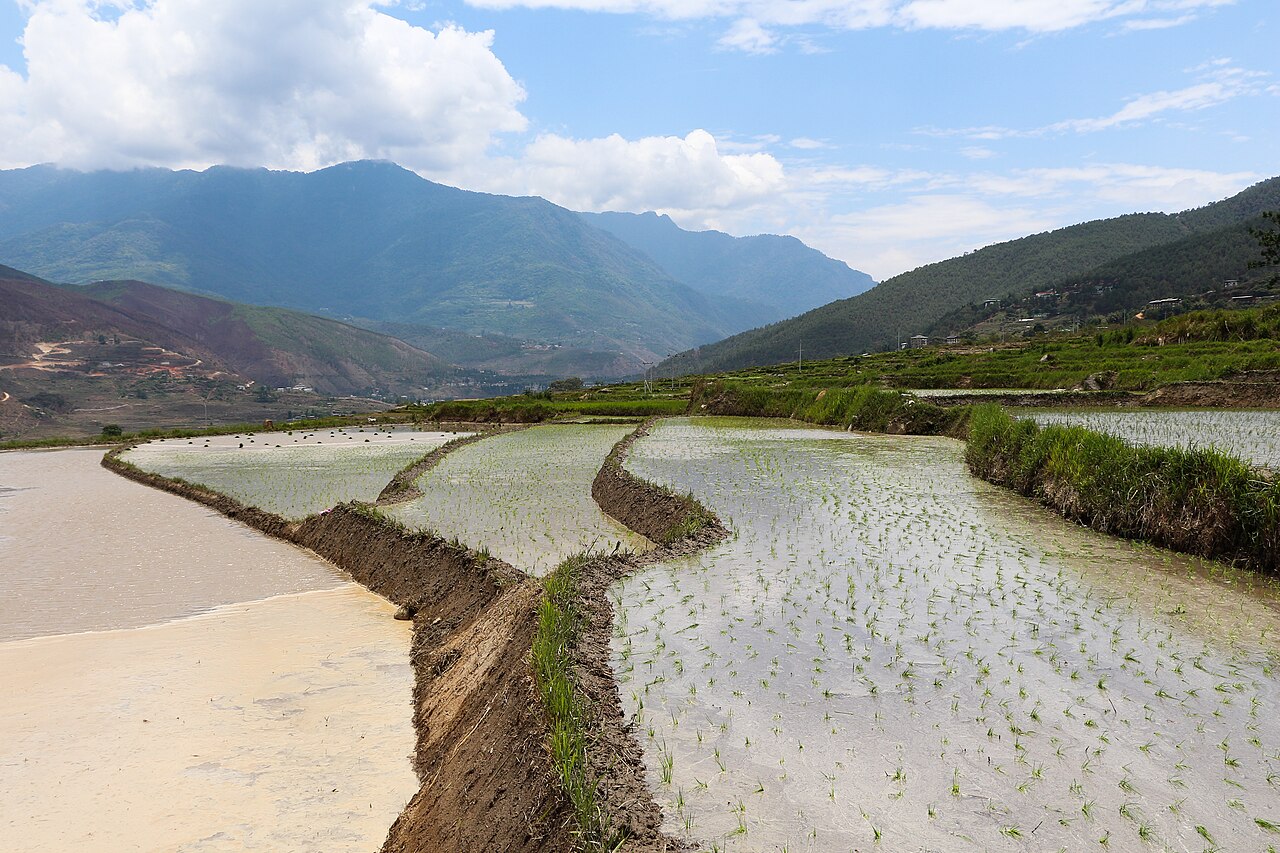

Agriculture is the foundation of Bhutanese society and the primary source of livelihood for more than half the country's population of approximately 780,000. Despite the sector's declining share of gross domestic product — from over 50 percent in the 1980s to roughly 16 to 18 percent in recent years — farming remains central to the lives of most Bhutanese, particularly in rural areas where subsistence agriculture is the dominant economic activity. Bhutan's agricultural landscape is shaped by its dramatic topography, ranging from subtropical plains in the south (150 metres above sea level) to alpine zones in the north (above 4,500 metres), creating a mosaic of ecological niches with distinct cropping patterns.[1]
The Royal Government of Bhutan has identified agricultural modernisation as a priority for economic development, food security, and rural poverty reduction. Key challenges include small and fragmented landholdings, limited mechanisation due to steep terrain, labour shortages caused by rural-to-urban migration, human-wildlife conflict, and the effects of climate change on mountain agriculture. At the same time, Bhutan's position as a carbon-negative country with minimal chemical input use has generated interest in organic farming as a pathway to both environmental sustainability and premium market access.[2]
Cropping Patterns and Major Crops
Bhutan's crop production is dictated by altitude, rainfall, and soil conditions. The major staple crops are:
- Rice: Cultivated primarily in the western and central valleys at elevations between 150 and 2,600 metres. Bhutan is known for its red rice, a distinctive medium-grain variety with a nutty flavour that is a staple of the Bhutanese diet and a niche export product. Rice paddies are typically irrigated and terraced, representing some of the most intensive agriculture in the country.
- Maize: The most widely cultivated cereal, grown across a broad range of elevations. Maize is a primary staple in eastern and central Bhutan and is often grown on rain-fed hillside plots.
- Wheat and barley: Grown at higher elevations, particularly in central and eastern Bhutan. Buckwheat, both sweet and bitter varieties, is an important crop in the eastern districts of Bumthang, Trashigang, and Trashiyangtse.
- Potatoes: One of Bhutan's most commercially successful crops, particularly from the Bumthang and Paro valleys. Potatoes are exported to India and Bangladesh and represent one of the few agricultural products with significant commercial value beyond the domestic market.
Horticulture
The expansion of horticulture — particularly apples, oranges (mandarin), cardamom, ginger, and temperate fruits — has been a focus of agricultural policy since the 1980s. Apple cultivation, concentrated in the Bumthang and Paro districts, was introduced with Japanese technical assistance and has become an important cash crop. Mandarin oranges from the subtropical southern and eastern regions are exported to India and Bangladesh. Cardamom, a high-value spice, is grown in the southern foothills and has significant export potential. The government has promoted horticulture as a means of increasing rural incomes and reducing dependence on staple crop production.[4]
Livestock
Livestock rearing is an integral component of Bhutanese agriculture, particularly in the higher-altitude regions where crop cultivation is limited. Cattle (including the yak and its crossbreed, the dzo), pigs, poultry, and horses are the principal livestock types. Yak herding is practised by semi-nomadic communities in the northern alpine zones, where yaks provide milk, butter, cheese, meat, wool, and transport. In Buddhist Bhutan, the slaughter of animals is culturally sensitive, and much of the meat consumed in the country is imported from India. Dairy development has been promoted through cooperatives and improved breeding programmes, with some success in the western valleys.[5]
Land Tenure and Farm Size
Bhutanese agriculture is characterised by small, fragmented landholdings. The average farm size is approximately 1.5 hectares, though effective cultivated area is often much smaller due to the steep terrain. Land ownership is widespread, with most rural households owning their plots. The Land Act of 2007 governs land use and ownership, imposing ceilings on individual holdings and regulating the conversion of agricultural land to other uses. Despite legal protections, the trend toward consolidation of farming by ageing populations and the abandonment of marginal plots by younger migrants is a growing concern.[6]
Labour and Rural-Urban Migration
One of the most significant challenges facing Bhutanese agriculture is the loss of labour to rural-urban migration. As education levels have risen and urban employment opportunities have expanded (even if insufficiently), younger Bhutanese increasingly leave rural areas for Thimphu, Phuentsholing, and other towns. This trend has left farming communities with aging and shrinking workforces, making it difficult to maintain existing cultivation levels, let alone intensify production. The government has experimented with farm mechanisation programmes, but the steep terrain limits the applicability of conventional machinery, and labour-saving technologies suited to mountain farming remain underdeveloped.[7]
Human-Wildlife Conflict
Bhutan's commitment to environmental conservation, including maintaining over 70 percent forest cover and designating more than 50 percent of national territory as protected areas, creates significant tension with agriculture. Wild boar, deer, monkeys, bears, and elephants regularly damage crops and kill livestock, causing substantial economic losses to farming communities. Human-wildlife conflict is consistently cited by farmers as one of their most serious challenges. The government provides compensation and has promoted electric fencing and other mitigation measures, but the problem persists and is a significant driver of frustration and out-migration in rural areas.[8]
Food Security
Bhutan is not self-sufficient in food production. The country imports significant quantities of rice, vegetables, and other food items from India to meet domestic demand. Food self-sufficiency has been a stated policy goal, but achieving it is constrained by limited arable land (less than 8 percent of total area), low yields, and the structural challenges described above. Climate change poses additional risks, including altered precipitation patterns, increased pest and disease pressure, and glacial lake outburst floods that can damage lowland agricultural areas.[9]
Agricultural Policy and Modernisation
The Royal Government has pursued agricultural modernisation through successive five-year plans and dedicated programmes. Key initiatives include the promotion of high-value crops, investment in irrigation infrastructure, support for farmer cooperatives and marketing, introduction of improved varieties and farming techniques, and the development of organic agriculture. The Renewable Natural Resources (RNR) sector strategy aims to transform agriculture from a subsistence activity into a commercially oriented sector that provides viable livelihoods for rural populations while contributing to food security and environmental sustainability.[10]
References
- Ministry of Agriculture and Forests, Royal Government of Bhutan.
- "Bhutan Overview." World Bank.
- "Bhutan at a Glance." Food and Agriculture Organization.
- Ministry of Agriculture and Forests, Royal Government of Bhutan.
- "Bhutan at a Glance." Food and Agriculture Organization.
- Ministry of Agriculture and Forests, Royal Government of Bhutan.
- "Bhutan Overview." World Bank.
- "Bhutan at a Glance." Food and Agriculture Organization.
- "Bhutan Overview." World Bank.
- Ministry of Agriculture and Forests, Royal Government of Bhutan.
Related articles
Know something about this topic? Edit this article or . Anonymous contributions welcome — no account required.