The 2018 National Assembly election resulted in a second consecutive transfer of power, with the Druk Nyamrup Tshogpa (DNT) defeating the incumbent PDP. Dr. Lotay Tshering, an orthopedic surgeon with no prior political experience, became Prime Minister, continuing Bhutan's pattern of voting out the ruling party in every election.
.svg)
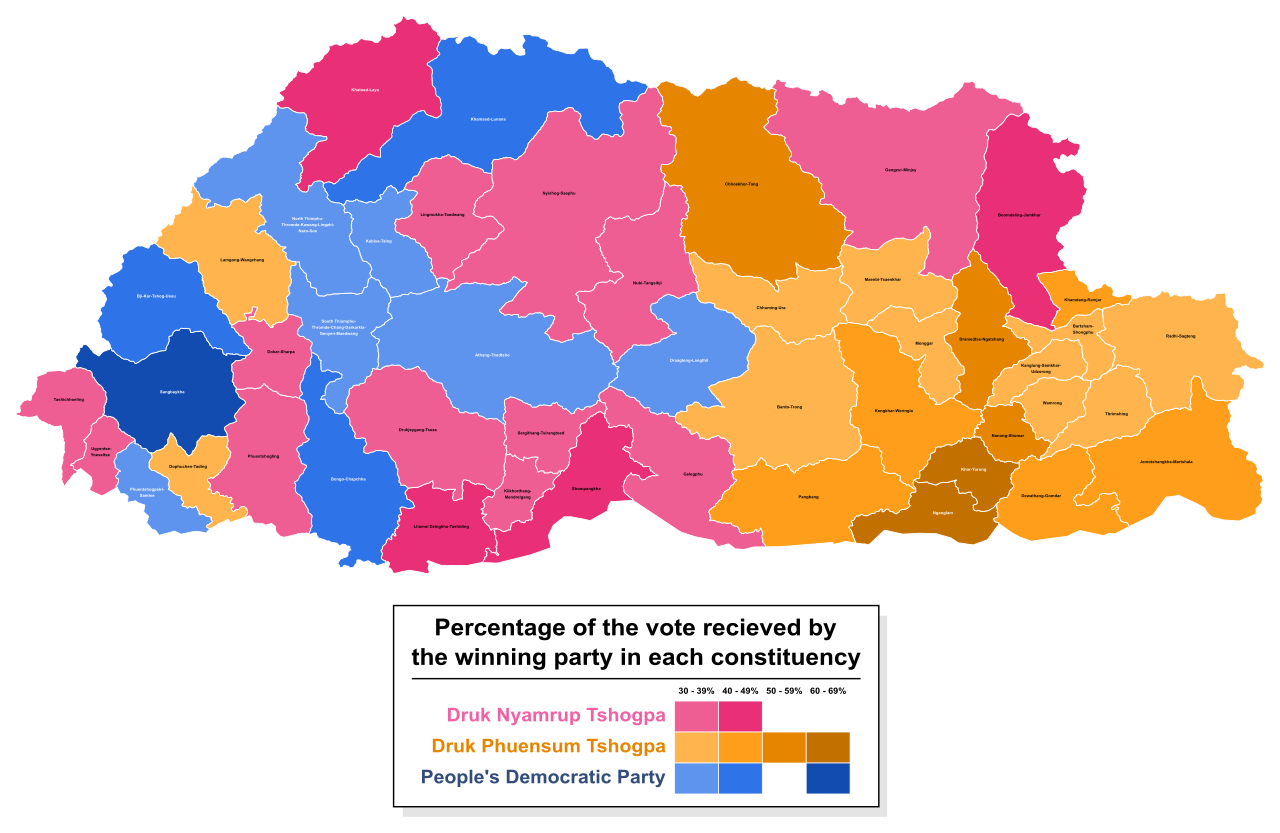
The 2018 Bhutanese National Assembly election, held on 18 October 2018, was the third general election in Bhutan's democratic history. The Druk Nyamrup Tshogpa (DNT), a relatively new party led by Dr. Lotay Tshering, won a convincing victory over the incumbent People's Democratic Party (PDP), securing 30 of 47 seats. The election continued Bhutan's remarkable pattern of alternating governments — in all three elections since the transition to democracy, voters had chosen to replace the ruling party, a phenomenon virtually unmatched among the world's young democracies.[1]
Background
The PDP had governed since 2013 under Prime Minister Tshering Tobgay. While the government had successfully stabilized relations with India and presided over steady economic growth, it faced criticism on several fronts. Youth unemployment remained stubbornly high, rural-urban migration was accelerating, and public debt — much of it tied to hydropower projects financed by India — continued to climb. Additionally, some voters felt that the pace of reform had not matched the PDP's ambitious campaign promises from 2013.
The primary round was held on 15 September 2018, with four parties contesting: the PDP, the DPT, the DNT, and the Bhutan Kuen-Nyam Party (BKP). In a surprise result, the DNT topped the primary with 34.43% of the vote, followed by the DPT at 31.85%. The ruling PDP finished a close third with 27.44%, narrowly missing the general election. This was the first time an incumbent party failed to advance past the primary round.[2]
The DNT and Dr. Lotay Tshering
The DNT had been founded in 2013 by Tandin Dorji and had performed modestly in that year's primary round. By 2018, under Dr. Lotay Tshering's leadership, the party had reinvented itself with a platform centered on healthcare reform, youth employment, and pragmatic governance. Dr. Lotay Tshering, an orthopedic surgeon trained in Australia who continued to perform surgeries on weekends even after becoming Prime Minister, brought an unconventional profile to Bhutanese politics. His lack of political background was recast as an asset — he was perceived as untainted by the established political class and genuinely motivated by public service.[3]
The DNT's campaign emphasized a "people-first" approach to governance, pledging to reduce the power distance between government and citizens, address the youth unemployment crisis through skills development and entrepreneurship support, and improve healthcare access in rural areas. The party also promised to diversify Bhutan's economy beyond its heavy dependence on hydropower.
General Election Results
The general election on 18 October 2018 saw the DNT win 30 seats to the DPT's 17, with approximately 54.95% of the popular vote going to the DNT. Voter turnout was approximately 71.46%, an increase from 2013 and reflecting heightened public engagement. The DPT, contesting its second general election as the non-incumbent party, improved its seat count from 15 to 17 but remained firmly in opposition.
Dr. Lotay Tshering was sworn in as the third democratically elected Prime Minister of Bhutan on 7 November 2018. His cabinet was notably smaller and younger than its predecessors, reflecting the DNT's emphasis on lean, efficient governance.
Key Policy Initiatives
The DNT government introduced several notable initiatives during its tenure. The De-suung (Guardian of Peace) volunteer program, originally launched by the King, was expanded significantly as a national service and disaster response framework. The government also pursued a "Narrowing the Gap" strategy aimed at reducing inequalities between urban and rural Bhutan, investing in rural infrastructure, connectivity, and service delivery.
During the COVID-19 pandemic, which struck in 2020, Bhutan's response under the DNT government earned international recognition. The country maintained extremely low case counts and zero deaths for an extended period through a combination of strict border controls, rigorous contact tracing, and a rapid vaccination campaign that achieved one of the fastest rollout rates in the world. Dr. Lotay Tshering's medical background was widely credited with informing the government's evidence-based approach to the crisis.[4]
Significance
The 2018 election solidified the pattern of anti-incumbency in Bhutanese politics and demonstrated the electorate's willingness to experiment with new parties and unconventional leaders. It also highlighted the importance of the primary round system — the PDP's elimination in the primary fundamentally altered the general election dynamic and underscored the volatility of voter preferences in Bhutan's young democracy.
The election of a surgeon with no political career reinforced the Bhutanese public's apparent preference for technocratic, service-oriented leadership over traditional political experience. This trend would be tested again in the 2024 election cycle.
See Also
- Elections in Bhutan
- Druk Nyamrup Tshogpa
- Lotay Tshering
- COVID-19 pandemic in Bhutan
References
- 2018 Bhutanese National Assembly election — Wikipedia
- Bhutan election: Ruling party eliminated in first round — BBC News, October 2018
- Bhutan's new PM says he will keep operating on patients — Al Jazeera, October 2018
- Bhutan's COVID-19 Response — World Health Organization
This article was contributed by BhutanWiki Editorial. It is licensed under CC BY-SA 4.0 and may be edited by any registered or anonymous contributor.
Test Your Knowledge
Think you know about this topic? Try a quick quiz!
Help improve this article
Do you have personal knowledge about this topic? Were you there? Your experience matters. BhutanWiki is built by the community, for the community.
Anonymous contributions welcome. No account required.