The 2013 National Assembly election marked the first democratic transfer of power in Bhutan, with the People's Democratic Party (PDP) defeating the incumbent Druk Phuensum Tshogpa (DPT) in a landslide victory. Tshering Tobgay became Prime Minister, ending the DPT's five-year tenure and demonstrating the maturation of Bhutan's young democracy.
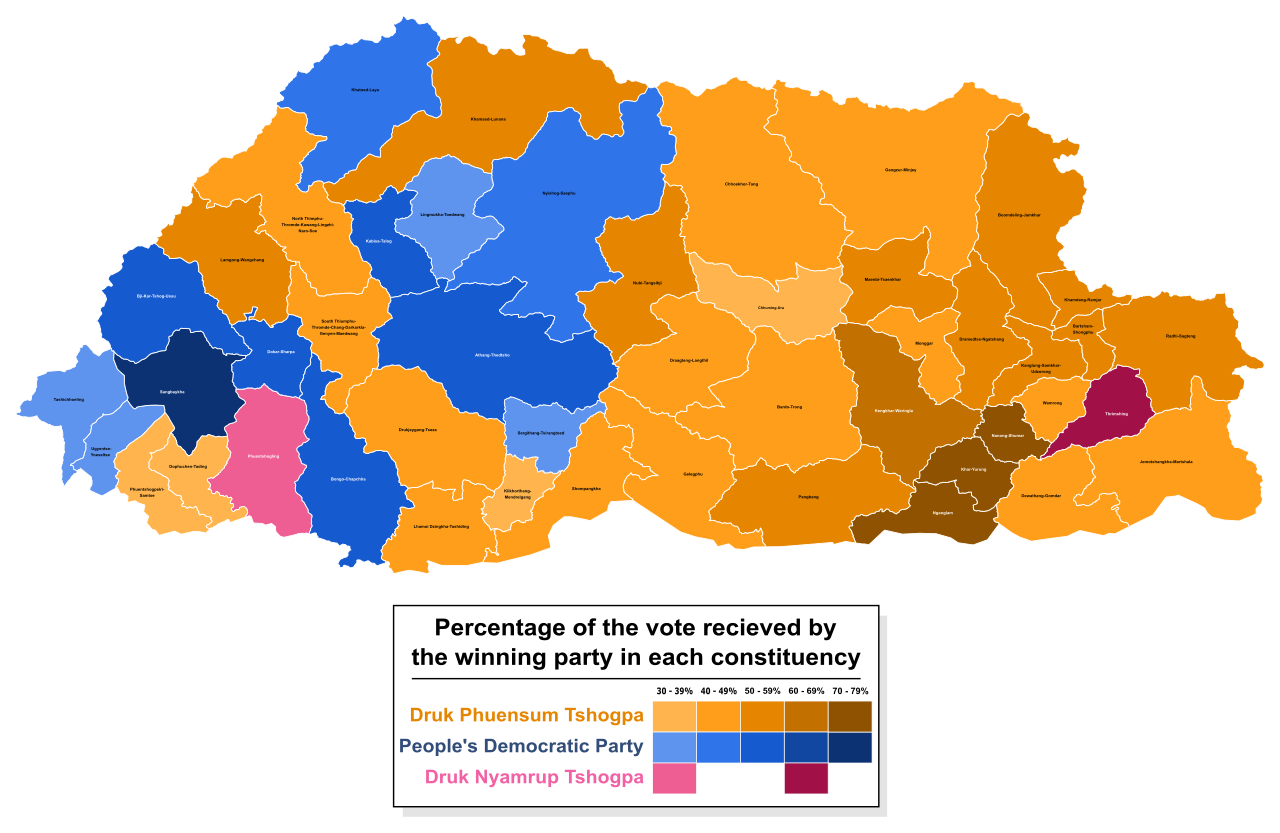
.svg)
The 2013 Bhutanese National Assembly election, held on 13 July 2013, was the second general election in the history of Bhutan and the first to produce a change of government through democratic means. The People's Democratic Party (PDP), led by Tshering Tobgay, won a decisive victory over the incumbent Druk Phuensum Tshogpa (DPT), capturing 32 of 47 seats in the National Assembly. The election demonstrated that Bhutan's transition to democracy, initiated by the Fourth King Jigme Singye Wangchuck, could sustain peaceful transfers of power — a critical benchmark for any young democracy.[1]
Background and Electoral System
Bhutan's electoral system, established under the 2008 Constitution, employs a unique two-round process. In the primary round, all registered parties compete, and the top two advance to the general election. This system ensures that the final contest is a direct two-party race, simplifying voter choice while preserving competitive dynamics. The Election Commission of Bhutan (ECB) oversees the process, maintaining strict regulations on campaign spending, media access, and candidate conduct.[2]
The 2013 primary round was held on 31 May 2013, with five parties competing: the incumbent DPT, the PDP, the Druk Nyamrup Tshogpa (DNT), the Druk Chirwang Tshogpa (DCT), and the Bhutan Kuen-Nyam Party (BKP). The DPT topped the primary with 44.52% of votes, while the PDP came second with 32.53%, setting up the general election contest between the two parties.
Key Issues and Campaign
The 2013 election was shaped by several contentious issues. The DPT government under Prime Minister Jigme Thinley had faced criticism over its management of Bhutan-India relations. A diplomatic strain emerged in 2012-2013 when India withdrew subsidies on cooking gas and kerosene sold to Bhutan, widely interpreted as displeasure with the DPT government's outreach to China. This "subsidy crisis" became a major election issue, with voters concerned about the economic fallout and the state of the bilateral relationship with Bhutan's most important partner.[3]
The PDP campaign focused on promises of transparent governance, improved relations with India, and economic reform. Tshering Tobgay, a former opposition leader with a background in engineering from the United States and experience in Bhutanese civil service, positioned himself as a pragmatic leader who could restore diplomatic stability while pursuing development goals aligned with Gross National Happiness (GNH) principles.
The DPT, meanwhile, defended its record of economic growth and infrastructure development during its first term (2008-2013). However, the party struggled to counter perceptions that it had mismanaged the India relationship, and several high-profile DPT members defected or expressed dissatisfaction with party leadership during the campaign period.
Results
The general election on 13 July 2013 produced a decisive PDP victory. The party won 32 out of 47 National Assembly seats, with approximately 54.88% of the popular vote. The DPT retained 15 seats with 45.12% of the vote. Voter turnout was approximately 66.2%, somewhat lower than the 79.4% recorded in the 2008 election, but still representing robust participation for a democracy only in its second election cycle.
The result was a comprehensive swing against the incumbent. The DPT lost 30 seats from its 2008 total of 45, while the PDP gained 30 seats from its previous total of 2. The magnitude of the shift surprised many observers and was attributed primarily to the India subsidy crisis, economic anxieties around rising public debt, and a desire for change among the electorate.
Significance
The 2013 election held profound significance for Bhutan's democratic trajectory. It established the precedent of peaceful power transfer, a milestone that many democracies take decades to achieve. The fact that the incumbent party accepted defeat gracefully and the transition of power proceeded smoothly reinforced public confidence in the democratic system.
International observers, including teams from the South Asian Association for Regional Cooperation (SAARC) and the International Foundation for Electoral Systems (IFES), assessed the election as free and fair. The ECB's management of the process was widely praised for its professionalism and neutrality.[4]
The election also highlighted the outsized role that the Bhutan-India bilateral relationship plays in Bhutanese domestic politics — a dynamic that would continue to influence subsequent elections. Tshering Tobgay's government moved quickly to repair relations with New Delhi, visiting India as one of his first official acts as Prime Minister.
See Also
- Elections in Bhutan
- National Assembly of Bhutan
- People's Democratic Party (Bhutan)
- Tshering Tobgay
References
- 2013 Bhutanese National Assembly election — Wikipedia
- Election Commission of Bhutan — Official website
- Bhutan's Democratic Transition — The Diplomat, July 2013
- IFES Bhutan 2013 Elections Report — International Foundation for Electoral Systems
This article was contributed by BhutanWiki Editorial. It is licensed under CC BY-SA 4.0 and may be edited by any registered or anonymous contributor.
Test Your Knowledge
Think you know about this topic? Try a quick quiz!
Help improve this article
Do you have personal knowledge about this topic? Were you there? Your experience matters. BhutanWiki is built by the community, for the community.
Anonymous contributions welcome. No account required.